
Parents of Disabled Children Often Rushed Into Abortions

One study that revealed parents of babies aborted due to disability of “fetal anomaly” suffer depression and loss said this:

“Despite the shock and grief they may experience upon hearing the news of a fetal anomaly, the pregnant woman and her partner are usually urged to make the decision to terminate quickly. Behind the urgency is the physician’s desire to avoid complications of “late” terminations of pregnancy. Because of the delays involved in amniocentesis, abortions may occur in the second and even third trimesters of pregnancy. In health care settings, the issue of such late abortions has raised ethical and legal questions. In one early study, most of the terminations occurred within 72 hours of the woman receiving the news of the abnormality. This hardly allows time for the couple to become informed about parenting children born with that anomaly and thus consider carrying through with the pregnancy.”

Donnai P, Charles N, Harris R. Attitudes of Patients after “Genetic” Termination of Pregnancy British Medical Journal 1981; 282: 621 – 622, P622 in Elizabeth Ring-Cassidy and Ian Gentles. Women’s Health after Abortion: The Medical and Psychological Evidence Second Edition (Toronto, Canada: The deVeber Institute for Bioethics and Social Research, 2003) 159

Read more about the abortion of disabled babies here. 

Share on Facebook
Eliminating “Defective” Babies

Rayna Rapp, who herself aborted it down syndrome baby, discusses abortions of disabled fetuses:

“New developments in reproductive technologies assist in the quest for the perfect baby not only by genetically creating “better” children but also by detecting and eliminating fetuses deemed abnormal and defective. In a world where babies are bred for desired characteristics, having a healthy, normal baby becomes nothing less than a duty. While it may appear that medicine simply offers procedure such as diagnostic ultrasound, fetal electrocardiography, and amniocentesis as options for those who desire them, the fear of producing a child that falls outside the boundary of “normal” compels many women to seek premonitory information regarding the status of the fetus. As one of [Rayna Rapp’s] interviewees explained regarding her tests, “if he was gonna be slow, if he wasn’t gonna have a shot at being President, that’s not the baby we wanted.”

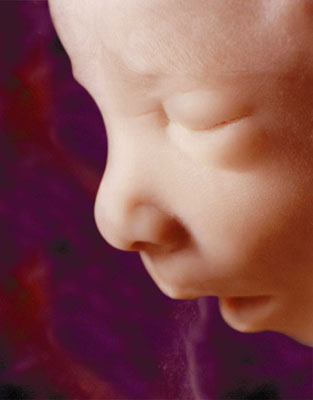
16 week-old unborn baby

Rayna Rapp “Moral Pioneers: Women, Men, and Fetuses on a Frontier Of Reproductive Technology,” and Hoffman et al., Embryos, Ethics and Women’s Rights, 110, from Kathy Rudy. Beyond Pro-Life and Pro-Choice: Moral Diversity in the Abortion Debate (Boston, Massachusetts: Beacon Press, 1996) 11

Incidentally, abortions for fetal anomaly are almost always late-term abortions – the tests that detect problems such as down syndrome can only be performed in the second trimester.


Share on Facebook

Mother of down Syndrome Baby Urged to Abort

Some estimates say that 90 – 92% of all babies with down syndrome are aborted. Many times, the medical professionals put pressure on women to have abortions when their baby is less-than-perfect:

“A woman I know was told by her obstetrician that her fetus had Down syndrome.  The doctor ordered her to abort, she refused….  Another woman was similarly coerced.  Her doctor told her that her baby would be more like a fish than a human and would only be as smart as a baboon.”

— From Lori B. Andrews book The Clone Age

Rebecca Taylor99% of Adults With Down Syndrome Report Being Happy in Life” LifeNews.com 10/6/11

Read more about this study here.

Share on Facebook

Study Shows That Abortion Is Not the Answer When a Baby Has Down Syndrome

An MSNBC article describes how people with down syndrome often lead happy lives, and that their families appreciate them,

“Among 2,044 parents or guardians surveyed, 79 percent reported their outlook on life was more positive because of their child with Down syndrome.”

“Skotko also found that among siblings ages 12 and older, 97 percent expressed feelings of pride about their brother or sister with Down syndrome and 88 percent were convinced they were better people because of their sibling with Down syndrome. A third study evaluating how adults with Down syndrome felt about themselves reports 99 percent responded they were happy with their lives, 97 percent liked who they are, and 96 percent liked how they looked.”

“Dr. Brian Skotko, a clinical fellow in genetics at Children’s Hospital Boston and lead study author, says he hopes the research on more than 3,000 Down syndrome patients and family members published in the October edition of the American Journal of Medical Genetics, will serve to better inform expectant parents and clinicians providing prenatal care.”

Kimbery Hayes Taylor “Down syndrome’s rewards touted as new test looms: Families report happy lives in first survey of impact of genetic condition” MSNBC NEWS 9/29/2011

80 to 90% of down syndrome children are aborted when the mother realizes that she is carrying a “defective” child.

Share on Facebook

Doctors Refused to Do Amniocentesis Unless Woman Agrees to Abort Imperfect Children

16 weeks – amniocentesis is done around this time, so babies aborted because of fetal anomaly are usually this age or older.

In his book on obstetrics and gynecology, author William Arney reveals the following:

“Some doctors refuse to do amniocentesis unless the woman is willing to commit herself, before the test is done, to an abortion in cases defective fetuses  are found.”

William Arney, Power and the Profession of Obstetrics (Chicago: University of Chicago press, 1982) 183 quoted in Kathy Rudy. Beyond Pro-Life and Pro-Choice: Moral Diversity in the Abortion Debate (Boston, Massachusetts: Beacon Press, 1996) 13 (Rudy is pro-choice)


It is clear that many doctors put pressure on women to abort their disabled and imperfect babies. Read more quotes about the abortion of handicapped children here.

Share on Facebook

Mother of Handicapped Child Horrified by Abortions

Mother of a five-year-old girl with a cleft lip and palate wrote this letter to the editor:

“I was horrified to read that many couples now opt for abortion rather than risk having a baby with such a minor physical imperfection. My daughter is not some abnormal freak… She can, and does, lead a happy, fulfilled life… What sort of society do we live in when a minor facial deformity, correctable by surgery, is viewed as so abnormal as to merit abortion?”

Susan Kitching, London Sunday Times, February 11, 1990

Read another mother of a handicapped child expressing her horror over abortion here. 

10 week old fetus
Share on Facebook

Mother of Down Syndrome Child Speaks Out

When tests reveal that unborn babies have Down Syndrome,the majority of women decide to terminate the pregnancy. Here are the reflections of one woman who has a child with Down Syndrome:

“Whenever I am out with Margaret, I’m conscious that she represents a group whose ranks are shrinking because of the wide availability of prenatal testing and abortion. I don’t know how many pregnancies are terminated because of prenatal diagnosis of Down syndrome, but some studies estimate 80 to 90%… Margaret does not view her life as unremitting human suffering (although she is angry that I haven’t bought her an iPod). She’s consumed with more important things, like the performance of the Boston Red Sox in the playoffs and the dance she’s going to this weekend. Oh sure, she wishes she could learn faster and have better math skills. So do I. But it doesn’t ruin our day, much less our lives. It’s the negative social attitudes that cause us to suffer.

Many young women, upon meeting us, have asked whether I had “the test.” I interpret the question as a get home free card. If I say no, they figure that means I’m a victim of circumstance, and therefore not implicitly repudiating the decision they may make to abort if they think there are disabilities involved. If yes, then it means I’m a right-wing antiabortion nut whose choices aren’t relevant to their lives.

Either way, they win.”

Patricia E Bauer “Selective Abortion Is Immoral” in Lucinda Almond The Abortion Controversy (New York: Greenhaven Press, 2007) 25-26

Read more about abortion and disability here.

Share on Facebook

Genetic Testing and the Coercion to Use It

“The mere existence of a [genetic] technology contains an implicit coercion to use it… Sometimes the coercion is more than implicit.”

Lori Andrews, Future Perfect: Confronting Decisions about Genetics (New York: Columbia University press, 2001), 63

Paige Comstock Cunningham, Esq. “The Supreme Court and the creation of the two-dimensional woman” Erika Bachiochi. The Cost of “Choice”: Women Evaluate the Impact of Abortion” (San Francisco, CA: Encounter Books, 2004)

Read an example of such coercion here.

Share on Facebook

Medical Professionals “Discourage the Birth” of Children with Deformities or Handicaps

“Through the gradual introduction of new forms of technology and testing, the medical establishment and the public health sector have been developing subtle quality-of-life standards and not-so-subtle ways of discouraging the birth of those who do not measure up.”

Elizabeth Kristol. “Picture Perfect: the Politics of Prenatal Testing” First Things 32 (April 1993): 22

Quoted in Paige Comstock Cunningham, Esq. “The Supreme Court and the creation of the two-dimensional woman” Erika Bachiochi. The Cost of “Choice”: Women Evaluate the Impact of Abortion” (San Francisco, CA: Encounter Books, 2004)

Read an example of such coercion here. 

Share on Facebook

Counselors Expected to Help Women Abort

Counselors are often made available to pregnant women who are being tested to see if their babies have health issues. Author Paige Comstock Cunningham quotes writer Elizabeth Crystal saying:

“Within the medical literature there is a clear assumption that counselors are there, in effect, to help patients through the difficult process of agreeing to be tested and agreeing to abort in the event of a diagnosed defect….”

Elizabeth Kristol. “Picture Perfect: the Politics of Prenatal Testing” First Things 32 (April 1993): 24

Quoted in Paige Comstock Cunningham, Esq. “The Supreme Court and the creation of the two-dimensional woman” in Erika Bachiochi. The Cost of “Choice”: Women Evaluate the Impact of Abortion” (San Francisco, CA: Encounter Books, 2004)

The implication is that a woman who has an amniocentesis or other test and discovers that the baby has a handicap will abort, and the counselors are there to guide her through the process. As you can see by reading other quotes in this section, women often feel coerced into aborting babies with defects, as medical personnel pressure them to do so.

Share on Facebook