An article in the national Catholic Register mentions counselor Heidi Heystek of Kalamazoo, Michigan, of Freedom Ministries, who is active in a post-abortion healing that was started in a prison.
The article says:
“Although statistics are hard to come by, Heystek estimates that up to 70% of women in prison have had a prior abortion.”
“Women Victimized by Abortion Strengthen Pro-Life Viewpoint” Nancy Valko “The National Catholic Register” Sept 13-19 1998
Pro-Choice author Melody Rose put together a table with statistics on how important the abortion issue is for Republicans versus Democrats.
The author examines the voting records of Republicans and Democrats on abortion related legislation between 1994 and 2005. Mathematically, she calculates that the average party unity score (instances of Republicans voting pro-life and Democrats voting pro-choice) was 87% for Republicans and 71% for Democrats—meaning that Republicans more consistently voted pro-life than Democrats voted pro-choice. She makes the point that the Republican Party is more committed to its antiabortion stand than the Democratic Party is committed to the pro-choice platform.
Melody Rose “Safe, Legal and Unavailable? Abortion Politics in the United States” (Washington DC: CQ Press) 2007
The most recent statistics from Planned Parenthood come from 2009. In 2009 Planned Parenthood performed more abortions than ever before: 332,278, 2.5% more than in the previous year. Abortion rates at Planned Parenthood have risen for the 15th straight year.
During that time, it has gone from committing 9.3 percent of all abortions in the United States to committing 27.5 percent.
Income from abortion accounts for 40 percent of Planned Parenthood’s annual clinic income.
97.6 percent of pregnant women going to Planned Parenthood are sold abortions while less than 2.4 percent of pregnant women received non-abortion services including adoption and prenatal care
There are 340 abortions for every one adoption referral
Read some women’s testimonies of Planned Parenthood’s biased and coercive abortion counseling:
National Survey of Obstetricians/Gynecologists on Contraception and Unplanned Pregnancy: Attitudes and Practices with Regard to Abortion,” Kaiser family foundation, 1995:
“Found that two thirds of the obstetricians and gynecologists in practice in the United States, especially female doctors and those under 40, refused to do abortions under any circumstances. Few of these mentioned public pressure from antiabortion activists as a reason; most cited religious scruples or simply said they didn’t like doing the procedure. Of the one third who do perform abortions, a majority do four or fewer per month.”
Erika Bachiochi. The Cost of “Choice”: Women Evaluate the Impact of Abortion” (San Francisco, CA: Encounter Books, 2004) 16 to 17
This means that the majority of abortions are done by a small group of doctors.
And, according to another poll:
Only 5 out of 100 obstetricians/gynecologists are now willing to perform abortions
Lawrence B Finer and Stanley K Henshaw, “Abortion Incidence and Services in the United States in 2000,” Perspectives on Sexual and Reproductive Health 35:1 (2003): 6 – 15
So the number has dropped dramatically between 1995 and 2003
A 1998 poll found that 58% of American women felt that the availability of abortion had hindered their relationships with men and 70% of men and women believed that legal abortion was not necessary for women to pursue various educational and career goals
Wirthlin Worldwide poll (1998), conducted for the Family Research Council, Washington DC
Candace C. Crandall “Three Decades of Empty Promises” in Erika Bachiochi. The Cost of “Choice”: Women Evaluate the Impact of Abortion” (San Francisco, CA: Encounter Books, 2004)
States with Restrictions on Post-Viability Abortions
reasons states permit third trimester abortions
restrictions on post-viability abortions
It should be noted that even in states where abortion is banned in the third trimester, loopholes in the law often allow these abortions to be performed anyway. Doe V Bolton, a companion case to Roe V Wade, mandated that a woman can’t be denied a third trimester abortion if her health is endangered by the pregnancy. It then went on, however, to define health broadly to include mental and emotional health. Therefore, all woman has to do to have a third trimester abortion is convince the abortionist that her mental or emotional health would be affected by the pregnancy. However, it is significant that many states have no laws on the books at all.
parental involvement and consent laws
This graph is of parental notification laws throughout the country.
The next few graphs are about public opinion in the abortion issue.
support for various pro-life lawschart on when in pregnancy abortions are acceptable to people
chart on opinions of partial-birth abortions
chart of opinions on abortion
chart on the abortion pill, RU-48pro-life versus pro-choice, public opinion
In 2009, the pro-life community gained a majority in America for the first time since Roe versus Wade.
Here are some statistics on teen pregnancy:
chart on teen pregnancy, now and in the pastgraph of teen pregnancy rategraph of the abortion rate
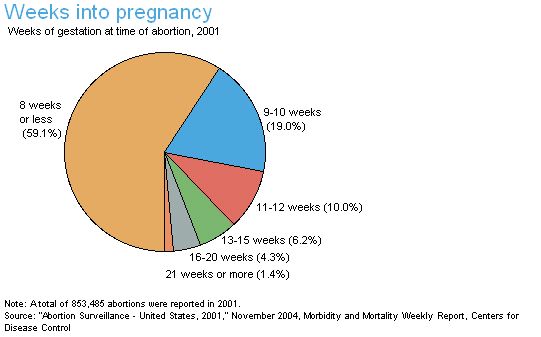
when in pregnancy abortions are performed
the following graph shows how having health insurance affects the abortion rate.
here are some charts on Planned Parenthood:
Number of Planned Parenthood AbortionsPlanned Parenthood – abortions versus adoptionsShare on Facebook