Susan Tew, an Alan Guttmacher spokeswoman(The Alan Guttmacher Institute, is an organization that researches abortion rates. It is affiliated with Planned Parenthood):
Most surgical abortions are done between seven and 12 weeks after a woman misses her period and after tests have confirmed pregnancy.
Mike Stobbe 23 years later, new sparks fueling abortion debate TheFlorida Times Union, Jan 22, 1996 pA-1
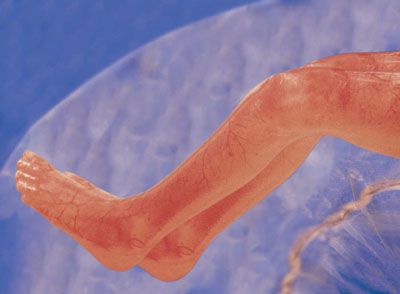
Legs of unborn baby at 12 weeks
Earlier abortions are more common now since RU-486 gives a woman the option to abort a soon she finds out she’s pregnant. The majority of abortions, however, continue to be performed after 6 to 7 weeks
One study showed that 70% of relationships broke up after the woman’s abortion. If the woman was in a relationship at the time of the abortion, it fell apart shortly after the abortion 70% of the time.
Vincent M. Rue “Abortion in Relationship Context” International Review of Natural Family Planning Summer 1985 p 105
NRTL tells of an incident in Pine Bluff, Arkansas when an abortion resulted in a live baby:
“In the examining room after the abortion, the doctor wrapped the baby in a towel and laid it aside while he finished caring for Marie. The infant continued to squirm and cry.
Soon afterward, Marie left the doctor’s office for a friend’s house nearby. The physician then placed the child in a sack and gave it to one of the two friends who had accompanied Marie…
In a few minutes, the woman with the sack arrived at the house where Marie was waiting. She said the doctor had told her to “take it along with you and pretty soon it will stop moving.”
After Marie fell asleep, the friends kept their death watch over the aborted infant until they decided to seek help.”
The baby survived.
Mike Masterson, “Baby Survives Abortion in Arkansas.” The National Right to Life News, August 4, 1983, 6
Aid to Women is a crisis pregnancy center in Canada which is located next to an abortion clinic. The government has been trying to shut them down, and police have repeatedly arrested the workers who sometimes try to talk to the women going into the clinic. At one point in the legal battle, the center gathered affidavits of women they helped. Here are the stories of two of them.
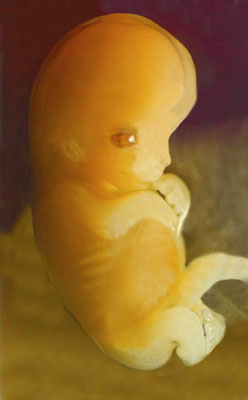
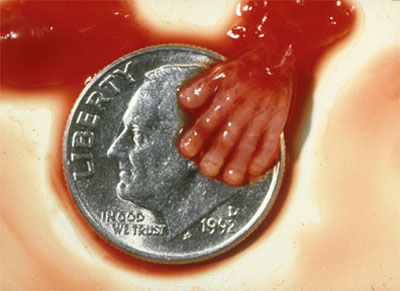
songram of baby at 11 weeks
“In December 1992 I was four months pregnant. At the time I had a boyfriend Chris who was not the child’s father.
We decided I would have an abortion. An appointment was made [at] The Cabbagetown Women’s Clinic on Gerrard Street [for an ultrasound] The people at the clinic did not tell me how big my baby was.
On the way out of the clinic [the abortion was scheduled for the following day] Chris and I met two men and a woman carrying signs. When we walked by them one of them asked if they could talk to us. We said it was OK….Chris and I accepted the invitation to go to Aid to Women next to the abortion clinic…After a while I decided not to have an abortion. Chris then went back to the clinic to get the money back. Since that day we got some more help from Aid to Women. They supplied us with baby clothes and a crib. Chris and I got married on Feb 13, 1993. My daughter Elizabeth was born on May 26, 1993…Aid to Women helped me find a doctor who delivered my baby for nothing.”
Another woman wrote:
12 weeks
“When I arrived, there was a long line of other women waiting for abortions. I could not see the doctor until I waited a long time. Eventually he saw me. He did an ultrasound examination of my abdomen to see the baby. When I asked to see it he refused. I asked him how big the baby was. He would not tell me. He said the abortion was going to be easy…However, by that time of the day I did not have time to wait for the abortion…I explained I had to leave. An appointment for the abortion was arranged for the next day, Nov 2, 1992. By that time in pregnancy, I could already feel the baby move inside me. I cried a lot on Nov 3 before I went to the clinic…Upon arrival at the clinic, I saw ladies outside carrying picture of unborn babies. I looked at the pictures and thought about my own baby. As I was going towards the door a lady asked “Can we help you?” I started crying …They asked if I knew how the baby looks like and they showed me a book about how the baby looks like as it grows inside the mother.
18 weeks. A mother can feel her baby move at about this time.
They also asked me about why I wanted an abortion. I told them about my financial probems…[They] helped me by paying my rent and helping to pay for the groceries [and] with maternity clothes and things for the baby. My daughter Emily wsw born on April 8, 1993.”
Leonard Stern “Abortion Wars” The Ottawa Citizen May 2000
“… half the sample endorsed being really scared and 40% agreed that they were scared that a termination might damage them emotionally or physically.”
Allanson S., Astbury J. The Abortion Decision: Reasons and Ambivalence. Journal of Psychosomatic Obstetrics and Gynecology 1995 September; 16 (3): 123 – 36, P130
For many women, these fears were justified. Read about physical and emotional harm of abortions.
The most pro-abortion category in the United States is white males between the ages of 20 and 45.
John Wilke: “The Real Woman’s Movement” National Right to Life News, December 14, 1989, three
The group that is most consistently pro-choice a single men.
Guy Condon, “You Say Choice, I Say Murder” Christianity Today, June 24, 1991, 23
This is an old statistic but it is very revealing to learn that many of the people who originally championed abortion were single men whose lives would be made easier if they did not have to support children or get stuck with child support payments.
The Playboy foundation made a $2500 donation to NARAL in 1971.
Bernard N Nathanson, M.D. with Richard N Ostling. Aborting America (Garden City, New York: Doubleday & Company, 1979) 149
NARAL is now known as NARAL Pro-Choice America, and is one of the biggest pro-abortion organizations in the United States. In the 1970s, when it was founded, it was active in trying to legalize abortion throughout the US. One of its founders, Dr. Bernard Nathanson, an abortionist, later became pro-life and produced the pro-life movie “the Silent Scream”, where an unborn baby can be seen fighting for his life while being aborted on ultrasound.
“A 1997 Gallup poll underlined the importance of reaching college-age women. It showed that the influence higher education had on opinions and attitudes about abortion was extraordinary and revolutionary. When men go to college they don’t change their opinion about abortion, although overall they are more for abortion than women. But women, when they graduate from high school, are more against abortion than they are for it. By the time they are graduated from a four-year institution, however, three out of four women support abortion.
It breaks down like this: When they enter college, 37 percent support abortion and 56 percent oppose it. Four years later, 73 percent support abortion. It’s that much of an increase.
These are old statistics, but still notable.
A Feminist Who Takes a Pro-Life Stand. Contributors: Stephen Goode – author. Magazine Title: Insight on the News. Volume: 17. Issue: 37. Publication Date: October 1, 2001. Page Number: 36.