
Indian women induce illnesses in unwanted baby girls, commit infanticide

Writer and researcher Gita Aravamudan describes how female babies were killed in villages in India:

“Female infanticide I found had become more “scientific”. Inducing pneumonia was the modern method. The infant was wrapped in a wet towel or dipped in cold water as soon as it was born or when it came back home from the hospital. If, after a couple of hours, it was still alive it was taken to a doctor who would diagnose pneumonia and prescribe medicine, which the parents promptly threw away. When the child finally died, the parents had a medical certificate to prove pneumonia. Sometimes the infant was fed a drop of alcohol to create diarrhea: another “certifiable disease.”

Gita Aravamudan Disappearing Daughters: the Tragedy of Female Foeticide (New Delhi, India: Penguin Books India, 2007)22

They did this because bodies could be exhumed so killing had to be done stealthily

Share on Facebook
New Zealand nurses do not want to assist doctors doing abortions

“It’s not an area of practice where many staff choose or are comfortable to work.”

Nurses have a particular difficulty with late-term abortions (usually described as abortions after 20 weeks or so)

“A lot of those nurses are quite happy to be involved in early abortions but with the increasing gestation they do find it difficult.”

Dr Sparrow said this was because of the greater development of the fetus, “rather than having a complete moral objection to abortion”.

Martin Johnson “More nurses opting out of abortion ops” NZ Herald Feb 4, 2009

Nurses in New Zealand have been refusing to participate in abortion procedures, particularly late term ones. Nurses participating in late-term abortions have to witness the extraction of fetal parts, including arms and legs, or tend to women who were delivering dead babies who have been injected with digoxin or another poison. It is not surprising that many of them are refusing to assist. Abortion has an emotional effect on providers as well as patients.

14 weeks
Share on Facebook

Posters in Chinese villages encourage women to abort

“Better to Let Blood Flow like a River Than to Have One More Than Allowed.”

“You Can Beat It out! You Can Make It Fall Out!  You Could Abort it! But You Cannot Give Birth to It.”

Posters set up by local authorities in Chinese villages supporting the one child policy.

Mara Hvistendahl Unnatural Selection: Choosing Boys over Girls, and the Consequences of a World Full of Men (New York: Public Affairs, 2011) 142

Share on Facebook

Sex selection Infanticide versus abortion in India

Gita Aravamudan wrote a book about the gender imbalance in China, India, and a number of other countries, brought about by the infanticide and abortion of girl babies. She describes the coming crisis as more and more men are unable to find partners, and chronicles how population control activists helped fuel the crisis. From her book:

One Indian woman, Lakshmi who had a living 4-year-old daughter and whose 2nd daughter died under mysterious circumstances (suspected infanticide) was 7 months pregnant and considered “high risk”was interviewed by the author. One of the men standing around her said:

“Look at her. If she has one more girl what will she do? Think of all the expenses. Think of all the clothes she will have to buy, the jewelry she will have to make. Think of the coming of age ceremony she will have to perform, the varadatchinai and seer varisai she will have to give. Where do you think the money will come from? One girl is bad enough…”

From Lakshmi herself:

“It is all very well for you town people to speak. You can afford to have yourself tested by machines and kill the girl child even when it is in the womb. In what way is that less of a crime? Is that not also killing? Has any town woman been arrested for that?”

Gita Aravamudan Disappearing Daughters: the Tragedy of Female Foeticide (New Delhi, India: Penguin Books India, 2007) 10-11

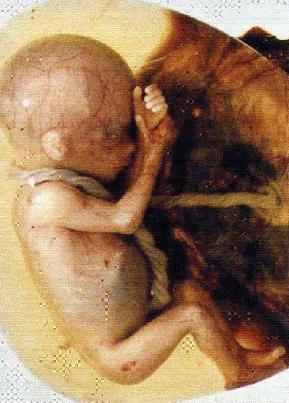
Lakshmi has a point. Is it so different to kill a baby right before birth or to kill her right after? Abortions for sex selection are by definition late-term abortions because the sex of the baby cannot be determined until 18 – 20 weeks.

20 weeks . Is killing this baby now morally acceptable while killing her a few months later is morally wrong?
Share on Facebook

Midwives kill baby girls in India

On infanticide in India:

“There are about 535,000 traditional birth attendants in Bihar for a population of 100 million. In several districts of the state, [the researcher] found that each midwife killed as many as 5 newborn girls a month. The study, released in 1995, was in a formal exercise, but [the researchers] believe that “if anything, the survey underestimated infanticide.”

An organization called Adithi, founded by Vigia Srinivasan, did the research.

Miriam Jordan “Brief Lives” Wall Street Journal, May 9, 2000


Share on Facebook

Chinese women talk about China’s One Child policy

In China, women are pressured, and in some cases forced, to abort if they already have one child. Abortion is extremely common and widely accepted. Here are 2 quotes from Chinese women about abortion:

“It’s a rather common occurrence, [like eating] an ordinary kind of food. There’s nothing worth talking about.”

And

It’s a very natural thing, like eating and drinking. It’s not against the law. And it’s quite safe to have [an abortion.”]

Few talk about the one child policy partly due to the fact that you can’t legally criticize the government in China and their one child policy. However, the results of the survey in 1997 done by Nie Jing-Bao gathered the following quotes:

“People have no choice [if they already have a child]; but most women want the babies.”

“Because people want more than one child, the government forces them to have abortions.”

“The family planning program forces people to have abortions. Some are voluntary, but most people have to [have an abortion]. Rural people hope to have more children. Most people in cities accept the family planning policy. Although some want to have more children, they may lose their job if they actually do so.”

In a study, 18 overseas students and scholars who had either just arrived in the United States or who had left China several years before were asked to list the reasons why women had abortions in China.

The number one response was “the requirements of the national family planning policy.”

Nie Jing-Bao Beyond the Silence: Chinese Voices on Abortion (New York: Rowman & Littlefield Publishers, 2005) 98-100

Share on Facebook

Oral histories in Australia indicate that illegal abortions were widely available

One researcher commented on illegal abortions which were performed in Australia before the liberalizing of abortion laws:

“Oral histories and memoirs suggest that most women who sought and found abortions had relatively safe operations… Research findings suggest that many or even most women could find a doctor, nurse, or skilled nonmedical provider to perform an “illegal” abortion before the middle of the century.”

Rebecca M Albury Beyond the Slogans: the Politics of Reproduction (St. Leonard’s, NSW Australia: Allen & Unwin, 1999) 7, 13

Legalizing abortion in Australia, like in the US, was not needed because thousands of women were dying from illegal operations. Read about the myth of back alley abortion deaths in America here.


Share on Facebook

Babies born alive after abortion in Canada

An article in a Canadian Institute for Health Information publication found the following instances of babies born alive after abortions:

19 weeks
  1. “A patient presented at 20 weeks gestation, requesting a therapeutic abortion. She was started on misoprostol, intravenously. The fetus was successfully expelled. A heart beat and respirations were detected at birth.”
  2. “Medical abortion at 23 weeks gestation for fetal anencephaly. Labour induced with intravenous Syntocinon. Fetus was born alive and survived for one hour.”
  3. “A patient presented at 19 weeks gestation for a therapeutic abortion. She was started on misoprostol intravenously. The fetus was expelled. A heartbeat was detected. The fetus expired 7 minutes later.”

Jonathon Kay ‘Homicide’ or not, abortion is a subject that too few Canadian politicians are willing to tackle” National Post 13/2/1

http://fullcomment.nationalpost.com/2013/02/01/jonathan-kay-homicide-or-not-abortion-is-a-subject-that-too-few-canadian-politicians-are-willing-to-tackle/

Share on Facebook

Chinese woman forced to have abortion, watches baby die

A woman from China who was allowed asylum in the United States had been forced to abort two children. She describes one of her abortions where the baby was born alive:

“I thought she [the baby] was alive. After it was aborted, [the nurse] threw it in the corner on the floor….I told them “It is alive baby, let me have it, raise it.” They said “no, because of the injection, it’s going to die soon….I saw her die and it was very painful. My heart got broken then.”

Chad Skelton “Woman Gets Refugee Status Despite No Fear of Persecution” The Vancouver Sun June 2, 2000

Read about babies born alive after abortions in the United States.

Share on Facebook

Belief in Christianity Has Radical Effect on Chinese Views on Abortion

A study was done where Chinese men and women were interviewed and asked their opinions on abortion. Chinese women are pressured to have abortions if they try to have more than one child. They are fined, and sometimes imprisoned  and forced to abort.

Here are the statistics:

Percentage that considered abortion:

taking a life: 36%

killing an infant: 31%

killing a human being: 27%

among Protestants

taking a life: 64%

killing an infant: 60%

killing a human being: 57%

among Catholics

taking a life: 92%

killing an infant 96%

killing a human being 88%

“Abortion in itself has nothing to do with ethics or morality.

71% agreed

77% of Catholics disagreed

56% of Protestants disagreed

“Under some situations, it is necessary to force a woman to have an abortion.”

75% agreed

25% of Catholics agreed

According to the author of the study:

“… conversion to Christianity (after having no particular religious commitment) signaled a radical change in attitudes toward the fetus and thus toward abortion.”

Table 4.2 Percentages of Respondents Who Agreed That Abortion Was Equivalent to Taking a Life, Killing an Infant, or Killing a Human Being

Nie Jing-Bao Beyond the Silence: Chinese Voices on Abortion (New York: Rowman & Littlefield Publishers, 2005) 110-112

Share on Facebook