Abortion Provider: Andre Nehorayoff

Abortionist Andre Nehorayoff’s medical license was suspended in 1991 for negligence and incompetence when he worked at the Manhattan Women’s Health Center. One 18-year-old woman died of what a medical examiner described as “hemorrhage due to incomplete abortion” in 1989, and another had died at his hands about ten years earlier. The court record also stated that a 36-year-old woman had an emergency hysterectomy after he lacerated her uterus, and he also delivered a portion of an 18-year-old woman’s bowel through her cervix.

In 1992, the Board of Regents revoked his medical license for the negligent treatment of five patients from 1983 to 1990 and poor record keeping, court records stated.

In March 2000, the New York State Appellate Division reversed a lower Supreme Court ruling and required the Board of Regents to reconsider restoring the license of Nehorayoff, who practiced in Manhattan.

Assistant Attorney General Patrick Barnett-Mulligan argued that the 1963 graduate of Tehran Medical School in Iran cried all day and couldn’t sleep for three nights when he lost his license, but had little remorse for his patients.

In 1993, the abortionist tried to get his license back. Two years later, he appeared before the Peer Review Committee, which concluded Nehorayoff had “sufficiently fulfilled the standards of remorse, rehabilitation and re-education” to practice again with three years’ probation. Another professional review by the Committee on Professions also recommended he return to the practice of medicine, but with 10 years’ probation.

In 1997, the New York State Board of Regents refused to return the abortionist’s medical license because of the seriousness of his offenses and his “lack of an appropriate degree of concern.” The board also noted the concerns of a consultant. Nehorayoff took the Regents to court, but the Supreme Court sided with the Regents. The Appellate Division court, however, ruled the lower court failed to make a balanced review of evidence. The appellate justices said that the abortionist was contrite, accepted punishment and attended classes to improve his skills and knowledge. In a dissenting opinion, Appellate Division Justice Thomas Mercure said his colleagues shouldn’t have overruled the lower court because the Regents decided restoring the license would pose a risk to the public.

References: “Incompetent Abortion Practitioner Could Get Back License.” Steven Ertelt’s Pro-Life Infonet at http://www.prolifeinfo.org/infonet.html, March 27, 2000; Associated Press, March 24, 2000; New York State Office of Professional Discipline, Committee Order #12342

Credit: Abortionviolence.com


Share on Facebook

Abortion Provider: Kermit Gosnell

Gosnell left dozens of damaged women in his wake. His reckless treatment left them infected, sterilized, permanently maimed, close to death, and, in at least two cases, dead. Their injuries and deaths resulted directly from Gosnell’s utter disregard for their health and safety. However, if their fate was entirely foreseeable, it was not necessarily the product of specific intent to kill. The same cannot be said of untold numbers of babies – not fetuses in the womb, but live babies, born outside their mothers – whose brief lives ended in Gosnell’s filthy facility.

The doctor, or his employees acting at his direction, deliberately killed them as part of the normal course of business.

Gosnell and his staff severed the spinal cords of viable, moving, breathing babies who were born alive.

Surgical abortions in Pennsylvania, performed up to 24 weeks of gestational age, are legal. Killing living babies outside the womb is not. The neonatologist who testified before the Grand Jury defined “born alive.” According to this expert witness, the federal Born-Alive Infants Protection Act defines a human as “somebody who’s been completely expelled from the mother and has either a heartbeat, pulsating cord, or is moving.”

Pennsylvania’s Abortion Control Act defines “born alive” similarly, but adds breathing and brain wave activity as indicators of life. 18 Pa.C.S. §3203. Gosnell’s staff testified about scores of gruesome killings of such born-alive infants carried out mainly by Gosnell, but also by employees Steve Massof, Lynda Williams, and Adrienne Moton. These killings became so routine that no one could put an exact number on them. They were considered “standard procedure.” Yet some of the slaughtered were so fully formed, so much like babies that should be dressed and taken home, that even clinic employees who were accustomed to the practice were shocked.

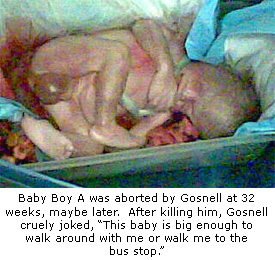
Baby Boy A

One such baby was a boy born in July 2008 to 17-year-old we will call “Sue.” …. An ultrasound conducted by Kareema Cross recorded a gestational age of 29.4 weeks. …. Eventually, she gave birth to a large baby boy. Cross estimated that the baby was 18 to 19 inches long. She said he was nearly the size of her own six pound, six ounce, newborn daughter. ….After the baby was expelled, Cross noticed that he was breathing, though not for long. After about 10 to 20 seconds, while the mother was asleep, “the doctor just slit the neck,” said Cross. ….

Baby Boy A was among the more memorable large babies that Gosnell killed, perhaps because of the photographs, or because his teenage mother almost died too. He was not, however, the only one. Ashley Baldwin remembered Gosnell severing the neck of a baby that cried after being born. The baby had “precipitated” when the doctor was not in the clinic. Lynda Williams placed the baby in a basin on the counter where the instruments were washed and called the doctor to come.

Ashley heard the infant cry. She saw the baby move while it was on the counter. She estimated the infant was at least 12 inches long. When Gosnell arrived at the clinic, she recalled, “he snipped the neck, and said there is nothing to worry about, and he suctioned it.”

The Routine

If Gosnell was absent, his employees would kill viable babies. Ashley Baldwin saw Steve Massof slit the necks of babies that moved or breathed “five or ten” times. Massof, repeating what he had been taught by Gosnell, told her that that it was standard procedure to cut the spine in all cases. Ashley testified:

o Q. These larger babies, when Dr. Steve was there, did he ever – was he ever there when any of the larger babies precipitated?
o A. Yes
o Q. Babies that would move?
o A. Yes.
o Q. So, Dr. Steve – what would Dr. Steve do with babies that moved?
o A. The same thing.
o Q. The same thing. And how many time did you see Dr. Steve?
o A. A lot. He told me that “don’t worry about it. They are not living. It is just a reaction.”

Kareema Cross testified that, between 2005 and 2008, she saw Steve Massof sever the spinal cords of at least ten babies who were breathing and about five that were moving.

When Massof left the clinic in 2008, Lynda Williams took over the job of cutting baby’s necks when Gosnell was not there. Cross saw Williams slit the neck of a baby (“Baby C”) who had been moving and breathing for approximately twenty minutes. Gosnell had delivered the baby and put it on a counter while he suctioned the placenta from the mother. Williams called Cross over to look at the baby because it was breathing and moving its arms when Williams pulled on them. After playing with the baby, Williams slit its neck. When asked why Williams had killed the baby, Cross answered:

o Because the baby, I guess, because the baby was moving and breathing. And she see Dr. Gosnell do it so many times, I guess she felt, you know, she can do it. It’s okay

Adrienne Moton also killed at least one baby by cutting its spinal cord. Cross testified that a woman had delivered a large baby into the toilet before Gosnell arrived at work for the night. Cross said that the baby was moving and looked like it was swimming. Moton reached into the toilet, got the baby out and cut its neck. Cross said the baby was between 10 and 15 inches long and had a head the size of a “big pancake.” Gosnell later measured one of the baby’s feet and said that it was 24.5 weeks.

Gosnell’s illegal and unorthodox practices resulted in the birth and then killing of many viable, live babies.

Killing really had to be part of Gosnell’s plan. His method for performing late term abortions was to induce labor and delivery of intact fetuses, and he specialized in patients who were well beyond 24 weeks. Thus, the birth of live, viable babies was a natural and predictable consequence. The subsequent slitting of spinal cords, without any consideration for the babies’ viability, was an integral part of what Gosnell’s employees called his “standard procedure.”

Steve Massof described this “standard procedure.” It required the clinic’s unequipped staff to manage a clinic full of sedated patients who were thrown into full labor, and then to “deal” with whatever precipitated, including live babies – all while the doctor was at home, or jogging, or working at a clinic in Wilmington. In particular, Massof described what Gosnell expected him to do when babies precipitated in the afternoon and evening before the doctor arrived:

o A: As I mentioned earlier, Dr. Gosnell would dilate the cervix to make room for passage of the products. And with the Cytotec, softening the cervix, the outlet of the uterus, well, mother nature would take its course. Every woman is different.
o Q: What would happen?
o A: Well, the fetus would precipitate.
o Q: What do you mean?
o A: Oh, come right out, right out. Just you know, I would be called, somebody would call me and at that point what I would have to do is, I’d have to go and tend to that patient.
o Q: How would you do that? What would you do?
o A: As – well, my first – my first reaction would be is at that point it depended sometimes it happened in the waiting room, sometimes it happened in the bathroom because, you know, a woman would be pushing in the bathroom. Sometimes, you know, it happened everywhere in the clinic.
o So what I would do is, I’d make sure that when – if the fetus precipitated, the cord was cut. Also, a standard procedure, the cervical spine was cut, as well as make sure that there wasn’t bleeding or, in other words, the placenta came down and that’s the way we insured less blood would be lost.
o Q: How often did this happen?
o A: More times than I really care to remember. I would have to say every week it would happen to at least 50 percent of the patients.
o Q: Fifty percent of the time?
o A: Yeah, easy, easy. That – you know, and that is how, you know, and that’s what would happen.
o Q: You said it was standard procedure to cut the – first to cut the umbilical cord?
o A: Yes.
o Q: That’s from the mother or how is that attached?
o A: Well that is from the mother to the fetus.
o Q: And where would it be? Would it still be – the placenta would still be in the mother’s uterus?
o A: Yes.
o Q: Okay.
o A: Yes. And so I would cut the attachment and you know, then the cervical portion of the spine at that point. Those were the larger patients.
o Q: So you said that was standard procedure. What do you mean when you say standard procedure?
o A: Well, that’s – that was his standard procedure.
o Q: When you say his, do you mean Gosnell?
o A: Yes.
o Q: Did he show you how to do that?
o A: Yes, he did.
o Q: When did he show you how to do that?
o A: He showed me how to do that maybe 2004, sometime within a year I started working there, that is what he did during his [second-trimester] procedures.

Tina Baldwin corroborated that this was Gosnell’s standard procedure. She explained that after a fetus was expelled, Gosnell “used to go ahead and do the suction in the back of the neck.” She saw this “hundreds” of times. Gosnell told her that this was “part of the demise.”

The Crime

Gosnell’s technique of aborting pregnancies by inducing labor and delivery, while unnecessarily painful for the women, did not itself constitute a crime. What made his procedure criminal was that he routinely performed these abortions past the 24-week limit prescribed by law. Not only was this a crime in itself, it also meant that he was regularly delivering babies who had a reasonable chance of survival. Except Gosnell would not give them that chance. Pennsylvania law requires physicians to provide customary care for living babies outside the womb. Gosnell chose instead to slit their necks and store their bodies in various household containers, as if they were trash.

Although the Grand Jury learned that there is some difference of opinion as to the earliest point of viability, the experts who appeared before the Grand Jury all agreed that, by 24 weeks, organs are sufficiently developed that prognosis for survival is good. These babies can sometimes breathe on their own, though many require assistance. When a woman delivers at 24 weeks or later in a responsible medical setting, such assistance is provided, and resuscitation of the baby is routine. Indeed, a doctor’s failure to provide assistance constitutes infanticide under Pennsylvania law.

Gosnell’s intent to never resuscitate was obvious from his failure to employ even minimally qualified personnel or to have the equipment necessary to save the lives of newborn infants. The policy he instituted and carried out was not to try to revive live, viable babies. It was to kill them.

Gosnell severed spinal cords and suctioned and crushed skulls after the babies were fully delivered.

At one point in his Grand Jury testimony, Steve Massof tried to suggest that the clinic’s practice of cutting babies’ spinal cords was somehow part of a late-term procedure called intact dilation and extraction (IDX), commonly referred to as “partial birth abortion” and banned under federal law since 2007. In an intact dilation and extraction, which was used most often to abort pregnancies beyond 17 weeks, the fetus was removed from the uterus as a whole. In order for the head to pass through the cervix without damage to the mother, the doctor would collapse the fetal skull by making an incision at the base of the neck and suctioning the contents. This procedure was done while the baby was still inside the mother.

This was not the procedure Gosnell used. Under further questioning, Massof acknowledged that Gosnell and he almost always cut the spinal cords, and sometimes suctioned skulls as well, after the babies were fully expelled by their mothers, when there was clearly no need or medical reason to collapse the skull.

Tina Baldwin’s testimony also made it clear that Gosnell was not cutting spinal cords, crushing babies’ skulls, or suctioning in order to allow the head to pass through the cervix. Even while claiming that Gosnell sometimes suctioned a fetus’s skull in order to get it through the birth canal, her description of his technique belied her claim: She said that he would “crack” the neck after the head was out – when only the baby’s torso was still inside the mother – and then suction the brain matter out. Tina Baldwin tried to explain:

o Q: He was delivering, for lack of a better word …
o A: Yes.
o Q: — a fetus?
o A: Yeah.
o Q: And then he was taking care of the problem after the fact?
o A: Yes.
o Q: Did you see him do this in instances where the fetus had been completely expelled from the mother’s body before he crushed the head?
o A: And then he crushed it.
o Q: and then he crushed it. I mean I guess you just told the members of the jury about episodes where he would leave the shoulders or –
o A: Uh-huh.
o Q: — the shoulders would be out?
o A: The shoulders would be out, yeah
o Q: And he would go work on the neck, you said he would crush the neck and suction the head?
o A: Uh-huh.
o Q: Did you ever see instances where the fetus was completely expelled from its mother’s body?
o A: Oh, yeah, yeah. That’s what we call precipitation.
o Q: What do you mean by that? Tell the members of the jury, what would happen?
o A: That’s when a patient would precipitate. Usually by the Cytotec that was given to the patient and it just made the uterus so flimsy to where the baby just falls and we had a lot of patients that was second-trimester, it would just fall wherever she was at. And it was picked up and it was put in a dish and it just traveled with the mother. And then the person put the mother up on the table, the baby was put inside the – in the dish on the table and the doctor was called to come in.
o Q: And then what would the doctor do when he came in?
o A: Let me think back then. Usually he would check and see, check on the fetus and then I think that’s when he used to go ahead and do the suction in the back of the neck.
o Q: Even though the fetuses had already been removed from their mother?
o A: Yeah, they had already been removed. He would just go ahead and finish it.
o Q: Would he explain to you why he did that?
o A: No.
o Q: Or why that was his practice?
o A: No.
o Q: Did you ever question it?
o A: No.
o Q: Okay, how many times would you say you’ve seen this?
o A: Hundreds. I’ve seen hundreds. . . .

The Brief Switch to Digoxin

Kareema Cross testified that when she first started working at the clinic, in 2005, Gosnell slit the neck of every baby. But he subsequently told the workers that the law changed so that he could not do that anymore. (The law, in fact, never allowed him to cut necks of viable babies after they were fully expelled.) Cross said that Gosnell then tried a few times to use a new procedure: He tried to inject a drug called digoxin into the fetus’s heart while it was in the womb. This was supposed to cause fetal demise in utero. But because Gosnell was not skillful enough to successfully administer digoxin, late-term babies continued to be born alive, and he continued to kill them by slitting their necks. Cross testified:

o So he tried to do the needle in the stomach and that’s what was supposed to have killed the baby before the baby came out, but if it didn’t, he’ll say, oh, well, the law says that I can do it. I can still slit the baby’s neck because it didn’t work. The needle didn’t work.

And according to his staff, the needle never worked. So Gosnell stopped trying and reverted to his old system of killing babies after they were born.

“Snipping”

Gosnell’s staff testified that he constantly tried to explain to them why what he was doing was legal – even though it clearly was not legal. Severing the spinal cord of viable, live babies after they have been delivered is simply murder. To then crush and suction their skulls defies medical explanation. It can only be understood as an attempt to conceal the true and only purpose of the neat scissor incision at the back of the neck: to kill the babies.

The clinic’s employees used the term “snip” to describe the severing of the spinal cord, but this is misleading. Our neonatal expert testified that, because of the bony vertebrae surrounding the spinal cord, it would actually take quite a bit of pressure to cut all the way through the spinal cord and the bone – even at 23 or 24 weeks gestation. At 29 weeks, on babies such as Baby Boy A, the expert said, “it would be really hard.” The baby, we were told, would feel “tremendous pain.”

When we asked our medical experts if there could be any legitimate, medical purpose behind Gosnell’s practice, one said: “it would be the same as putting a pillow over the baby’s face, that the intention would be to kill the baby.” Another likened the practice of severing babies’ spinal cords to pithing frogs in biology class.

Gosnell and his staff regularly cut necks of viable babies after observing signs of life.

Although no one could place an exact number on the instances, Gosnell’s staff testified that killing large, late-term babies who had been observed breathing and moving was a regular occurrence. Massof said that Gosnell cut the spinal cord “100 percent of the time” in second-trimester (and, presumably, third-trimester) procedures, and that he did so after the baby was delivered.

Massof testified that he saw signs of life in some of these babies. He recalled seeing a heartbeat in one baby and observed a “respiratory excursion” (meaning a breath) in another. On other occasions, he observed “pulsation.” Gosnell dismissed these observations as “spontaneous movement.” “That was his answer for if we ever saw anything that was out of the ordinary, it was always a spontaneous movement.”

Latosha Lewis testified that she saw babies precipitate at 23 to 28 weeks. In those cases, Massof or Gosnell:

0 … would cut the back of the neck and insert a curette, which is a plastic tubing … that is used to do a suction. You would insert it in the back of the neck of the baby, so that the brain would come out.

Sometimes, according to Lewis, “he [Gosnell] would just snip the neck.” Lewis saw babies move before Gosnell did this:

o Q. How many times did you see precipitated babies that had been fully expelled from its mother moving before he snipped the neck?
o A. A lot.

* * *
o Q. Can you give us a percentage of the time?
o A. Probably 25 percent of the time.

No steps were ever taken to attend to these babies; “we never even checked to see if [there] was a heartbeat.” Lewis, who had herself given birth twice, recognized that the larger precipitated babies were viable:

o … The bigger cases, you would see more movement or the baby would look a little bit more realer to you.
o Q. What do you mean?
o A. Like the skin would be a lot different. The color of the skin would be a lot different.

The Grand Jurors learned from the neonatology expert that the skin of viable babies does, in fact, appear different from the typically translucent skin of a pre-24-week fetus.

Kareema Cross said she saw Gosnell slit the neck of babies born alive “more than 15 times” : “over 10 times,” when she had seen a baby breathing, and about “five times” when she had seen a baby move. She could tell these babies were breathing because “I just seen a baby’s chest go up and down and it would go real fast, real fast.”

Ashley Baldwin also saw Gosnell slice the neck of moving and breathing babies. When asked how many times Ashley had observed babies being delivered that were moving or breathing or crying and the doctor cut the neck, she answered: “Most of the second tris that were over 20 weeks.” She said this happened probably dozens of times, maybe more. She described at least 10 babies as big enough to buy clothes for, to dress, and to take care of. She told the Grand Jury what happened to them:

o Q. And what happened to those ten babies that came out from their mother, that were big enough that you could put clothes on and take home and take care of, that moved around, what did you see happen to them?
o A. He killed them.
o Q. Who killed them?
o A. Doc.
o Q. How did he kill them?
o A. He cut the back of the neck.

Ashley said Gosnell told her this was “normal.”

Tina Baldwin told the jurors that Gosnell once joked about a baby that was writhing as he cut its neck: “that’s what you call a chicken with its head cut off.”

Although Massof was not as cavalier about what he did, he admitted that there were about 100 instances in which he severed the spinal cord after seeing a breath or some sign of life:

o Q. … of those 100 how many were larger than 24 weeks?
o A. That I couldn’t tell you for sure. I would have to think that they would all be because they were all able – after a certain period in weeks, you know, there’s – they would have to be capable. I mean premature births are quite common.

When investigators raided the clinic in February 2010, they sent the fetuses they discovered to the Philadelphia medical examiner’s office. The medical examiner concluded that two of them – aborted at 26 and 28 weeks – were viable, and another, aborted at 22 weeks, was possibly viable. The 28-week fetus, a male (Baby Boy B) had a surgical incision on the back of the neck, which penetrated the first and second vertebrae. The 22-week fetus, female, had a similar incision.

We believe, given the manner in which Gosnell operated, that he killed the vast majority of babies that he aborted after 24 weeks. We cannot, however, recommend murder charges for all of these cases. In order to constitute murder, the act must involve a baby who was born alive. Because files were falsified or removed from the facility and possibly destroyed, we cannot substantiate all of the individual cases in which charges might otherwise have resulted.

While the evidence before the Grand Jury supports only a limited number of murder charges, it is without challenge that Kermit Gosnell, under the pretext of providing medical care, routinely killed viable babies and irreparably damaged women. At least two of his patients, he also killed.

Above: Example of a slit neck – Baby Boy B


Share on Facebook

Abortionist molests patient, keeps filthy clinic

According to medical board documents, abortionist Lawrence Alozie Akpulonu allegedly raped patient “A.A,” who was under anesthesia for an abortion by Akpulonu at Midland Medical Center on January 28, 1995. A complaint to the California Medical Board states that:

“A.A. awoke to find respondent raping her; he had penetrated her vagina with his penis. Respondent gave patient A.A. a shot and she went back to sleep. When patient A.A. woke up a second time, she saw respondent next to her. She saw his erect penis out of his pants. She tried to push him away … Respondent then gave her another shot and she went back to sleep. When patient A.A. awoke for a third time, she found her sweater had been removed and her bra partially pulled down exposing her right breast. Respondent was caressing patient A.A.’s body … when patient A.A. tried to scream, respondent placed his hand over her mouth. Respondent told patient A.A. she had a beautiful body. He said she was a very nice girl and a very sexy girl while he continued rubbing her inside her blouse and bra. He kissed her right breast. He then placed his business card inside her bra and said she could call him anytime.”

He was found guilty of negligence and gross deviation from standard of care in this behavior and in the excessive injections given to A.A.

In other incidents, Akpulonu was arrested for committing perjury on government documents. He was also given probation for brandishing a loaded handgun in front of pro-lifers and threatening their lives. Akpulonu also pleaded guilty to medical insurance fraud. On November 19, 1991, Akpulonu threatened a parking garage attendant with a loaded .380 caliber semi-automatic pistol, which he had been carrying concealed in his vehicle, when the attendant asked him to remove his improperly parked car from a restricted area. Original charges of exhibiting a firearm, carrying a concealed weapon in a vehicle, and carrying a loaded firearm in a public place were amended to add a charge of disturbing the peace; Akpulonu pleaded nolo contendere to the added charge February 20, 1992, and the remaining charges were dismissed.

Medical board documents alleged that Akpulonu billed Medi-cal for x-rays on patients S.T. (October 22, 1986), C.C. (November 11, 1986), D.C. (December 16, 1985), and E.D. (December 13, 1986); false or fraudulent Medi-Cal claims totaling $9300 on 62 additional patients in 1989 and 1990, such as billing once as an abortion D&C and once for a non-obstetrical D&C for the same abortion; billing $5970.40 fraudulently as new patient visits for 98 previously billed patients; submitted fraudulent pathology bills on 43 patients when pathology services were included in other billed procedures; 15-count felony complaint filed against respondent and Shirley Akpulonu September 9, 1987; on August 9, 1988, 16 counts were dismissed in a hearing and 10-count Felony Information was filed August 15; March 13, 1991, he pled guilty to a misdemeanor offense.

There were many official inspections of Akpulonu’s Midland Medical Center abortion clinic, and every one of them revealed recurring threats to patient health that were not corrected;

Akpulonu, who is a podiatrist by training, ran his filthy Midland Medical Center abortion mill for years, and kept his clinic open despite at least seven health inspections that found numerous threats to the lives and health of his patients. Akpulonu’s case is a perfect example of how states are perfectly willing to let bad abortionists continue to threaten the lives of women, just because they want abortion to stay fully available. When reading this list of inspection failures, consider what the authorities would do to a pro-life crisis pregnancy center if it had such a lousy inspection record it would be shut down after it failed the first inspection!

A July 17, 1991 inspection found

– A filthy rest room with no toilet paper;

– Reports of unsterile instruments being used in the operating room;

– Fumes persevering after anesthesia;

– No registered nurse at the facility;

– Akpulonu performing abortions alone, with no assistant;

– No scrub room and inadequate supply of gowns and gloves;

– Blood on floor and curtains of the operating room;

– Facility operating with an expired license; and

– Blood specimens discarded rather than sent to a lab for testing.

August and September 1991 inspections found

– Employees were trained to clean hoses used in medical procedures in running cold water by working the hoses manually to flush out all blood and tissue;

– Surgical gloves not worn;

– Employees trained to dump tissue jars into the sink and run the contents through the garbage disposal;

– Medical instruments were in cold water in the sink and put in the autoclave, which was rusty and too small to permit closing of the lid when the instruments were in it;

– No pathology reports on abortion tissues;

– Disposable plastic syringes being re-used;

– Clinic smelled of rotting tissues, surgery room splattered with blood, and some other rooms were extremely dusty; and

– Rat droppings found in the surgery room and in the hall.

A May 1993 inspection found

– Respondent did not use gloves during medical procedures and advised his medical assistants that they did not need to use gloves unless they had a cut on their finger or hand;

– Respondent brought his entire staff into the examination room to observe a patient who had a severe case of genital warts;

– No pathology reports done on abortion tissues;

– No refrigeration for blood and tissue samples or for medications;

– No on-site equipment for handling emergencies;

– Fetuses less than 18 to 24 weeks were flushed down the garbage disposal;

– Equipment not properly sterilized between procedures;

A July/August 1993 inspection found

– Staff were now flushing fetuses of less than five months down the toilet;

– Staff were not trained in infection control;

– Equipment was still not being sterilized between procedures;

– Employees were assisting in medical procedures were not provided aprons, masks or hair covers; and

– Staff were re-using single use equipment such as plastic equipment inserted in patients’ vaginas, and tubing that transported products of conception.

A September, 1993 inspection found

– A foul odor in exam rooms;

– A dirty autoclave containing rusty, dirty, tissue-encrusted instruments;

– An employee containing dirty equipment without wearing gloves because the employee had been instructed by Akpulonu that, if the employee desired to work at respondent’s clinic, the employee would not wear gloves when dealing with bodily fluids; and

– When the employee indicated intent to report this to health authorities, Akpulonu told the employee he would see to it that the employee never got another job in the health care field;

A February 1994 inspection found

– Blood products improperly stored in improperly labeled, leaking containers;

– No soap, antiseptic, or towels at handwashing facilities;

– Improper storage of hazardous waste;

– Inadequate personal protective equipment for staff;

– Missing emergency equipment;

– Poor housekeeping;

– Improper record keeping; and

– Training was inappropriately given by an employee with only one week of employment and did not include information on the handling of an exposure incident;

A March 1994 inspection found:

– IV needles were not disposed of properly;

– There were improperly labeled blood products stored in open cupboards;

– There were still no towels at the handwashing site;

– The emergency exit was blocked;

– There were no gowns, face shields, or goggles for staff;

– The emergency equipment was still missing;

– The housekeeping was still poor;

– The record keeping was still inadequate;

– Biohazardous waste was improperly stored in paper boxes; and

– Maintenance room contained an unlabeled and blocked electrical panel as well as a floor covered with large wires creating a hazard.

On January 14, 1995, Akpulonu hired a nurse on the spot, but she quit after only four hours of working in his filthy abortion clinic. Among other health hazards, she observed in a complaint to the California Medical Board;

– rusty metal speculums;

– rusty forceps;

– instruments cleaned with dishwashing liquid;

– a lack of lifesaving equipment;

– no apparatus for administering anesthesia;

– cockroaches in the operating room;

– no medical swabs in the operating room;

– no alcohol in examining or operating rooms;

– a ‘rancid blood smell’ in procedure rooms;

– no refrigerator to store pathology tissues;

– no containers for biohazardous materials;

– no needle disposal units in examining room or operating room;

– used needles left on tables in the operating room; and

– improper handling of fetal materials.

The nurse’s complaint to the California Medical Board stated that

“Akpulonu performed five abortion procedures. … I saw old specimens, apparently from earlier abortions performed the day before, in urine sample glasses stored in the medicine cabinet. … When Akpulonu began the abortion procedures, he did not allow anyone else in the room with him. There was no nurse or assistant with him. … After the procedures, Akpulonu asked me to empty the products of conception from the gauze bag attached to the vacuum aspirator into containers. … he referred me to the medicine cabinet. The only containers in that cabinet that could have held the specimens were the plastic urine sample glasses. I followed instructions and then asked an intern if that was the standard procedure at the clinic. She said it was. The specimens sat on the counter for several hours. … Based upon what I saw in the short time that I was there, it does not appear that Akpulonu is sending any specimens to a pathology lab. … I truly believe that someone will become seriously injured if something is not done immediately.”

References: Los Angeles Times, January 31, 1993; News Notes. “A Gentle Touch.” The Wanderer, March 2, 1995, page 3; California Medical Board Accusation Number 17-95-46707 dated March 21, 1995.

Credit: Abortionviolence.com

Share on Facebook

Abortion Provider: Gerald Applegate

Julie Speicher, the mother of two small children, went to abortionist Gerald Applegate (who also took care of women with wanted pregnancies) on February 24, 2000 for a routine monthly checkup because she was five months pregnant with her third child. During this checkup, Applegate determined that her unborn child had died, and decided to perform the removal procedure, called an evacuation, in his office, but it failed. The next day, Applegate tried to remove the preborn child again. But Speicher’s condition deteriorated and she stopped breathing.

Applegate called 911, and paramedics inserted a breathing tube and took her to UPMC Passavant Hospital, where she died the next day, February 26, 2002.

The Allegheny County coroner’s office classified Speicher’s death as a “therapeutic misadventure.” She was 32 and left behind her husband, their son, Adam, 6, and daughter, Alyssa, 4.

In December 2001, Speicher’s family filed a wrongful death suit against Applegate and UPMC Passavant Hospital, alleging that Applegate improperly started the operation in his North Hills office and was unprepared for the emergency that resulted. The suit says that Applegate should have begun the operation in a hospital because he and his staff were unable to deal with an emergency in the office. He had no nurse-anesthetist, did not monitor Speicher’s vital signs, did no blood testing and, when Speicher stopped breathing, didn’t know how to intubate her because he’d never done it, according to the suit. The abortionist also did not perform a procedure called osmotic dilation to soften the cervix, which the suit said is a mandatory precaution in second trimester evacuations.

The suit also says that Applegate lied about his previous lawsuits when he applied for staff privileges at Passavant, and that Passavant knew about Applegate’s problems and allowed him to stay on the staff.

Abortionist Applegate has a long history of hospital suspensions and malpractice lawsuits and was under suspension by Magee-Womens Hospital at the time of the operation. Applegate, who still has staff privileges at UPMC Passavant and Magee, had been under a three-month suspension by Magee at the time of the procedure, according to the suit, because of failure to respond to pages to deliver babies. He didn’t tell Speicher about the suspension, however, and used a Magee consent form for the procedure. Because Magee operated the obstetrics unit at Passavant, according to the suit, Applegate’s suspension at Magee meant he should have been prevented from using the Passavant facility. According to the suit, he also used his own equipment at Passavant, a violation of hospital policy.

The suit alleges that Applegate lied on his original 1993 application for privileges at Passavant by claiming he had no lawsuits against him when he actually had five. He was kept on junior active status for three years instead of one because he had 43 violations for failure to complete hospital charts on time, the suit says.

In all, Applegate has had nine medical malpractice lawsuits brought against him in 10 years and has changed insurance carriers three times, according to the suit, but Passavant did not suspend him.

References: Torsten Ove. “Young Mother’s Death Brings Lawsuit.” Pittsburgh Post-Gazette, December 18, 2001; “Abortion Practitioner Sued for Killing Woman After Miscarriage.” Pittsburgh Post-Gazette, December 18, 2001; Steven Ertelt’s Pro-Life Infonet at http://www.prolifeinfo.org/infonet.html, December 19, 2001.

Source: Abortioviolence.com

Share on Facebook

Abortion Provider: Curlee Ross

Curlee Ross has had numerous problems including medical malpractice (sued in the death of a patient) incomplete abortion and assault and battery.

Abortionist Curlee Ross had an assault and battery complaint filed against him by Lilliam Mackey alleging that Ross beat her severely about the face and body, causing her injury, evidently when she was serving papers on him. Ross settled the case out of court for $1500.

Source: LA County Superior Court Case No. C34287

******

Also:

A suit by Gordonna S. alleged that she underwent an abortion by Dr. Curlee Ross on October 1, 1971, at San Vicente. The following January she was discovered to be six months pregnant. Her infant Daniel was born April 7. (LA County

(Superior Court Case No. C 25559)

******

And the death:

Obstetrical suit by survivors of Ms. Cortez alleged: May 29, 1976, Cortez was pregnant, seriously ill and in great pain, in hospital, under care of Ross et al.; improper care, she died June 5, 1976 due to failure to properly treat eclampsia and toxemia; suit alleged Ross abandoned patient, “knowing her to be in critical condition, and in need of immediate medical care.”

(LA County Superior Court Case No. C179970)

Credits: Christina Dunigan and Abortionviolence.com


Share on Facebook

Abortion Provider: Morton W. Barke

Abortionist Morton W. Barke was indicted in 1972 of “conspiracy to cheat and defraud by committing the crimes of grand theft and of filing false claims;” “On February 14, 1972, Barke and [Walter] Appleman performed a total of fifty-one therapeutic abortions in 665 minutes while preparing reports and claims totaling 610 minutes for the eleven patients who were on Medi-Cal.”

February 18, 1972, Barke and Appleman filed claims for anesthesia for five simultaneous abortions; “On February 28, 1972, Barke and Appleman performed a total of 43 therapeutic abortions in 540 minutes while preparing reports and claims totaling 580 minutes for the 11 patients who were Medi-Cal recipients.” On March 15, 1972, Barke and Appleman filed claims for anesthesia for four simultaneous abortions; Barke pled nolo contendere to a misdemeanor of receiving stolen property in a plea bargain, was given 2 years probation without formal supervision and $1000 fine.

Reference: Los Angeles Superior Court Case #A308288.

Credit: Abortionviolence.com


Share on Facebook

Abortion Provider: Edgar A. Guess, Jr.

Abortionist Edgar A. Guess, Jr. was indicted for six counts of grand theft for filing false Medi-Cal claims.

Reference: Los Angeles County Superior Court Case #A331372.

Credit: Abortionviolence.com

Share on Facebook

Abortion Provider: Leonard Breslaw

Abortionist Leonard Breslaw got into trouble for insurance fraud and for prescribing controlled substances to drug addicts while his license was suspended.

He was convicted in 1972 of felony insurance fraud and perjury in connection with conspiracy to have his office burglarized to collect insurance money and denying said conspiracy in court.

Breslaw’s California medical license was suspended 180 days on January 28, 1982, with five years license probation. During his license probation period, he prescribed controlled substances “other than for a legitimate medical purpose and not in the usual course of medical practice …to persons not under respondent’s treatment for a pathology or condition other than addiction ..without either a good faith prior examination or medical indication.” He pled guilty to and was convicted of 10 counts of unlawful distribution of controlled substances. On December 15, 1986, he was fined $20,000 and given five years probation and a suspended five year prison sentence.

References: Los Angeles Municipal Court Case Number A-120918; California Medical Board Case Number D-3825.

Credit: Abortionviolence.com

Share on Facebook

Abortion Provider: Michael Rosenthal

Abortionist Michael Rosenthal, already on probation and without medical malpractice insurance, was stripped of his medical license after he acknowledged to the Medical Board of California that he misled patients, endangered their lives and attempted a second-trimester abortion.

Rosenthal admitted to the Board that he misled patients, lied to another physician, failed to reveal an abnormal pap smear result, failed to perform an ultrasound on a patient who had already delivered four babies by caesarean section, and started an abortion on a woman in her second trimester.

In an agreement dated September 24, 2001, he admitted gross negligence and incompetence. In an interview, he admitted to poor decisions that he made in part because he was taking Prozac that he prescribed to himself.

The Board accused him of botching three abortions in 1999, when he was running his own Upland, California-based abortion mill with the truly Orwellian name “Family Birthing Center.”

At the time his license was revoked, Rosenthal was on probation for two other incidents, one in 1986 and one in 1992. In the latter case, medical board prosecutors said he gambled that a pregnancy would be without incident and didn’t tell his patient that he had lost his privileges in San Antonio when he practiced there. His privileges were revoked after his insurance company stopped his malpractice coverage in 1992.

Rosenthal’s primary concern was not for the women he injured, but for the embarrassment his troubles would cause his wife, a former Mayor of Claremont. He showed his utter disregard for others when he said that “The single biggest thing is embarrassing Karen. I have resolved this in my own mind a long time ago. … For myself, I just don’t care.”

References: Tipton Blish. “Abortion Practitioner Admits Many Violations, Loses License.” Los Angeles Times, April 20, 2002; Steven Ertelt’s Pro-Life Infonet at http://www.prolifeinfo.org, April 21, 2002.

Credit: Abortionviolence.com


Share on Facebook

Abortion Provider: Edgar Ruiz

In February 2002, health and law enforcement officials shut down an unlicensed abortion clinic in West Hollywood, and are investigating whether the owner practiced medicine without a license. Abortionist Edgar Ruiz charged $200 in cash for abortions and catered to uninsured women, according to sheriff’s and county health department officials.

Ruiz told authorities he is licensed in his native Nicaragua, but does not hold a medical license in this country. A sheriff said that Ruiz drew “women wanting something cheap and discreet, something that wouldn’t leave a paper trail.” Ruiz told investigators that he has run his Centro Medico Para La Mujer abortion mill for four years in a medical building on Santa Monica Boulevard near the Hollywood Freeway.

Officials learned about the unlicensed abortion mill after a woman complained to county Supervisor Gloria Molina’s office on November 30, 2001 that the abortion practitioner had botched an abortion on her. An undercover sheriff’s deputy then visited the clinic posing as a patient, and Ruiz allegedly offered to perform a pelvic exam on her. Authorities then arrested Ruiz and seized hundreds of patient files and padlocked his abortuary.

His bail was set at $1 million. Investigators asked the district attorney’s office to file felony charges against Ruiz, alleging that he practiced medicine without a license with the risk of great bodily injury.

References: “Abortion Facility Shut Down in Hollywood.” Los Angeles Times, February 3, 2002; Steve Ertelt’s Pro-Life Infonet at http://www.prolifeinfo.org, February 4, 2002.

Credit: Abortionviolence.com


Share on Facebook