From an article in The Human Life Review about how media outlets often only present the pro-choice viewpoint, and often disseminate false information:
“The reason that so many liberals are ready to believe and disseminate the lies of the abortion industry is not that abortion has any inherent connection to liberalism but because liberals and abortion advocates belong to the same ethnic group. One day, after hearing on the radio some pretty long excerpts from a speech by a NARAL official, I listened for an opposing view. Hearing none, I called the station manager and asked why he didn’t put on a differing opinion, one from the pro-life side. His reply was that “we don’t have these people on our Rolodex.”
“Why They Help Them Lie.”, By: McKenna, George, Human Life Review, 00979783, Spring2001, Vol. 27, Issue 2
“A 1997 Gallup poll underlined the importance of reaching college-age women. It showed that the influence higher education had on opinions and attitudes about abortion was extraordinary and revolutionary. When men go to college they don’t change their opinion about abortion, although overall they are more for abortion than women. But women, when they graduate from high school, are more against abortion than they are for it. By the time they are graduated from a four-year institution, however, three out of four women support abortion.
It breaks down like this: When they enter college, 37 percent support abortion and 56 percent oppose it. Four years later, 73 percent support abortion. It’s that much of an increase.
These are old statistics, but still notable.
A Feminist Who Takes a Pro-Life Stand. Contributors: Stephen Goode – author. Magazine Title: Insight on the News. Volume: 17. Issue: 37. Publication Date: October 1, 2001. Page Number: 36.
“A twenty-one-year-old woman, unemployed, uneducated, without family, in the fifth month of her fifth pregnancy. A forty-two-year-old mother of teenagers, shocked by her condition, refusing to tell her husband. A twenty-three-year-old mother of two having her seventh abortion, and many women in their thirties having their first. . . .Oh, the ignorance . . . .Some swear they have not had sex, many do not know what a uterus is, how sperm and egg meet, how sex makes babies. . . .They come so young, snapping gum, sockless and sneakered, and their shakily applied eyeliner smears when they cry. . . .I cannot imagine them as mothers.”
“We do abortions here” Harper’s Magazine. Quoted in Jason Deparle, “Beyond the Legal Right; Why Liberals and Feminists Don’t like to Talk about the Morality of Abortion,” Washington Monthly Apr. 1989
1st trimester. The majority of abortions are done at this time
Even abortion-rights advocates are beginning to say that late abortions pose special problems. Compared with early abortions, post-20-week procedures are four times more costly, seven times more likely to lead to medical complications, and far more physically and emotionally traumatic to the woman. In recognition of these problems, more and more clinics are offering counseling before the abortion. “I don’t want laws to stop abortion at 20 weeks,” says Charlotte Taft, an abortion counselor and consultant in Santa Fe, N.M. “But I’d like us to consider how we, as a society, can take responsibility for the denial and ambivalence” that lead to late abortions.
When abortions come late in a pregnancy., By: Lavelle, Marianne, Glastris, Paul, Gerson, Michael J., Daniel, Missy, Meyer, Michele, U.S. News & World Report, 00415537, 01/19/98, Vol. 124, Issue 2
The director of one late-term abortion clinic discussed the legal furor over partial-birth abortions (or D & X abortions), in which a baby is partially delivered before being killed. She mentioned that D&E abortions, which have never been criminalized, are just as gruesome:
“If people object to D&X, what will they say when they get to this? D&E is the next battleground.”
When abortions come late in a pregnancy., By: Lavelle, Marianne, Glastris, Paul, Gerson, Michael J., Daniel, Missy, Meyer, Michele, U.S. News & World Report, 00415537, 01/19/98, Vol. 124, Issue 2
Scott Johnston of Silent No More, did the following interview with a nurse who worked providing abortions:
What kind of nursing were you ordinarily doing around the time that these abortions took place?
“Obstetrics.”
partial birth abortion diagram
How many partial birth abortions did you personally witness?
“Two full-term abortions. They were done at nine months.”
What do you know of the circumstances surrounding these abortions? Why were they being done?
“One of the mothers already had three or four and she didn’t want any more.”
18 weeks- a little young for a Partial Birth Abortion
“The other girl was single. She didn’t have a husband and had no means of support. I asked, ‘Why don’t you put the baby up for adoption?’ She said, ‘I don’t know how it would be treated.'”
“The doctor was an O.B. doctor. I would say he was not of the highest caliber either. He had a bad reputation. He had a lot of deaths of babies that were born because he did not take care of them properly. He was sloppy. Normally, this doctor would be in the farthest back delivery room. When they did abortions, the doctors usually had their own nurse. This one didn’t. He was a sleezeball.”
How did it come to be that you were present for these abortions?
“I did not know what I was going into. I was just told to assist him [the doctor]. They just told me which delivery room to go to.”
“The reason I was in on [the first trimester abortion] is because I said to the doctor: even in the first trimester those babies have pain. ‘I’ll bet you it hurts, too.'”
Eight weeks
Did you know ahead of time for each case that an abortion was going to be done?
“No.”
Who else was in the room?
“There was one other nurse.”
What were your nursing duties during these procedures?
“I was usually there to receive the baby and take care of the baby when it was born. Their little hands–they grasp for something. They try to grab hold of something.”
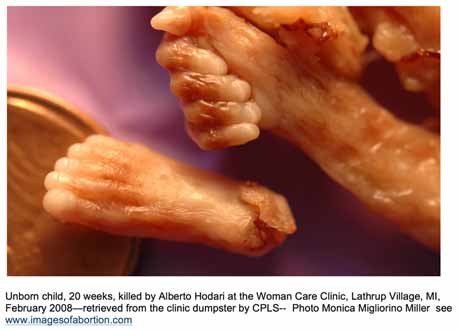
20-22 Weeks
Can you describe the partial-birth abortions you witnessed? What did you see?
“He turned the baby around [in the womb] and brought it out feet first. That’s one of the worse things for the mother that you can do. I was helping the doctor hold the baby [to keep it in the birth canal]. The other nurse got the instrument [a large syringe with a large needle], handed it to the doctor, and he inserted it into the base of the skull. Then he pulled the baby out. Its little hands were grasping. When the baby quit grasping, then he delivered it. He used the syringe to suction out the brains. That’s more traumatic on the mother than if she had given a normal birth.”
“They took the [dead] baby and wrapped it up in a receiving blanket and asked her [the mother] if she wanted to hold it. She said she didn’t want to. Neither one of them wanted to see them.”
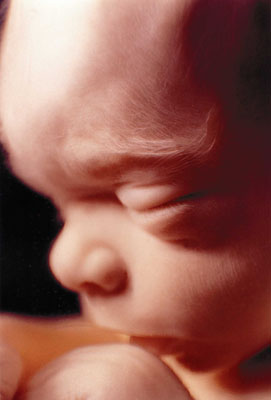
Aborted baby at 24 weeks
“They were sent to the morgue.”
What was your reaction?
“I was so sick. I was absolutely nauseous. I couldn’t believe all that was taking place.”
“I told the charge nurse I didn’t want to work with him anymore.”
“I think it’s such a horrible thing. I said a prayer for those babies.”
What was the reaction of the other personnel who were present with you at these abortions?
22 week abortion
“With the doctor, he was so nonchalant. It was no big thing.”
“I never saw her [the other nurse] reactions.”
You also witnessed a first trimester abortion. Please describe what happened.
“The doctor did a sonogram to show me that the baby didn’t feel it. On the sonogram, when he started the suction, the baby’s arms spread out. It immediately threw its hands out. Its little arms spread out. So, you know it had to feel it.
First trimester sonogram
[The instrument used for the first trimester abortion] it is a silver tube with stainless steel blades on it. He inserts it first, and then turns on the suction. The baby comes out all shredded. ‘Now, you watch this, and you’ll see how it doesn’t feel a thing.’ [The doctor said] I think it was kind of shocking to him. I looked at him and he looked at me, and then he wouldn’t look at me after that. I don’t think he had used a sonogram before during an abortion. It was over in a short period of time.”
Eight weeks sonogram
“That doctor is not here [at the same hospital] anymore. He had so many malpractice suits he had to leave town.”
What is the reaction of people you have talked to since then about what happened?
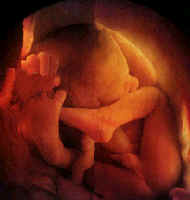
Six months – partial-birth abortions used to be done at this age. Now these babies are aborted by D&E
“Anybody who starts talking about partial birth abortion, I say, ‘Do you know what it is?’ And I tell them what it is! They just usually look kind of wide-eyed with their mouths open. And one girl said, ‘I don’t believe you.’ I said, ‘why should I stand up here and lie to you?’ Most people are just shocked.”
Among 917 women in the US Midwest, 26% of those who described themselves as moderate to heavy drinkers have had an abortion
Klassen AD, Wilsnack SC. Sexual Experience and Drinking among Women in a US National Survey. Archives of Sexual Behavior 1986 October; 15 (5): 363 – 92