Pro-abortion writer admits life begins before birth

Pro-Abortion author Katie Roiphe admits that abortion kills a life, and people know it:

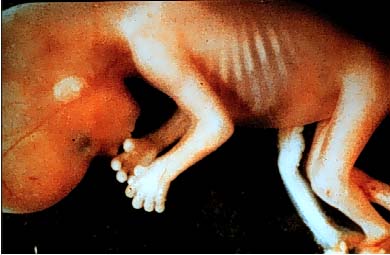
Preborn baby's toes at 7 weeks
Preborn baby’s toes at 7 weeks

“The idea that “life begins at birth” is useful politically, but as many have pointed out, in the age of sonograms, of cloudy little hands and feet coming into focus at nine weeks, how many people actually believe it?

Our language betrays our desire. A cluster of cells that is wanted is a “baby,” and one that is unwanted is a “fetus.” One never hears excited parents-to-be referring to the “fetus”; the leap of imagination from fetus to baby is so ordinary, so automatic, so universal that we cannot pretend, even in the realm of political expediency, that it is not so. We can’t try to argue that some clusters of cells are not “life” if we are, say, busy calling our own cluster of cells a baby….

Let’s imagine a scenario in which we admit that abortions may involve an obliteration of something that could legitimately be called life but that they are done to protect something that could also be called life. Planned Parenthood is, after all, in the business of protecting women’s lives, their futures, their ability to pursue education, to establish security, to have homes filled with future children, and their freedom to decide how best to use their short time on earth.”

Katie Roiphe “Good Riddance, “Pro-Choice” Slate JAN. 16 2013

Share on Facebook

Author explains why some Indian women may kill their baby girls

Author Gita Aravamudan writes about one reason why women in India are resorting to infanticide of girl babies:

“A woman who gave birth to girls had no value in her own home. If she produced too many she could be thrown out of her marital home. Her birth family too would reject her. Killing her own daughters, therefore, was an act of self-preservation. If she defied society and kept them alive, she would probably end up alone with the additional burden of bringing up her daughters all by herself.”

Gita Aravamudan Disappearing Daughters: the Tragedy of Female Foeticide (New Delhi, India: Penguin Books India, 2007) 35

Share on Facebook

Medical society in 1893: illegal abortion is “heinous”

In the 1800s abortion was illegal and medical societies thought abortionists who practiced illegally were the lowest of the low. here is one quote from 1893:

“The medical profession looks upon this crime as one of the most heinous, and as closely allied to infanticide. He who is believed guilty of such a crime could never be received into membership in this or any other medical society; or if a member should so far forget his high calling to be guilty of this crime, his expulsion would quickly follow upon the presentation of adequate evidence of his guilt.”

William Henry Parish “Criminal Abortion,” MSR 68 April 29, 1893 644 – 649

MSR Stands for Medical and Surgical Reporter

Frederick N Dyer The Physicians’ Crusade against Abortion (Sagamore Beach, Massachusetts: science history publications, 2005) 233

Share on Facebook

Only 61% of parents knew about their daughter’s abortion, study reveals

In an older study (1992) posted her for readers to consider

61% of parents knew about their unmarried teenage daughter’s abortion – 45% were told by the girl, 15% found out some other way

half of teens 15 years old and younger told their mothers while only 2/5 of older teens told their mothers

reasons for not telling their parents:

73% did not want to disappoint them

55% thought they would be angry

32% didn’t want the parents to know they had sex

78% the minor’s boyfriend was involved with the decision, he was 3 times more likely than the minor’s father to be involved. 54% reported that someone had tried to convince them to get an abortion, 40% reported that someone had tried to convince them to see the pregnancy to term

Stanley Henshaw and Kathryn Kost “Parental Involvement in Minor’s Abortion Decisions” Family Planning Perspectives volume 24 number 5 September/October 1992

Quoted in Mei Ling Rein. Abortion: an Eternal Social and Moral Issue (Wylie, Texas: Information Plus Reference Series, 2000)

Share on Facebook

Abortionist: baby in first trimester is “saltwater creature”

“I prefer to look at the problem [of abortion] through the eyes of Darwin and evolution. Why not permit abortion in the first trimester, when the embryo is still a salt water creature …?”

George Crile, Jr., M.D., retired abortionist

“When Does Human Life Begin?” Guest editorial in the Medical Tribune, March 6, 1985.

Below: 9 to 10 week (first trimester) unborn baby- a saltwater creature?

9 to 10 week (first trimester) unborn baby- a saltwater creature?


Share on Facebook

Genetics researcher explains why he used aborted babies for his experiments

“Monkey fetuses were more precious, as there were fewer of them available than human fetuses.”

Australian genetics researcher, answering a question as to why he used human fetuses in his experiments rather than monkey fetuses.

Quoted in Mark Kahabka. “Eugenics Revisited.” Fidelity Magazine, July/ August 1988, page 13

Share on Facebook

After Roe, proabortion forces changed from promoting abortion as a “right” to using the word “choice”

Pro-choice author Rickie Solinger  talks about how feminist groups stop talking about abortion as a “right” and instead framed it as an issue of “choice” in order to appeal to the public:

“… Until Roe, most activists claimed that “the right to control whether you’re pregnant or not [was] indivisible from the right to self-determination.”

The rights language, however, did not last very long… In a country weary of rights claims, choice became the way liberal and mainstream feminists could talk about abortion without mentioning the “A Word.” Many people believed that “choice” – a term that evoked women shoppers selecting among options in the marketplace – would be an easier sell; it offered “rights lite,” a package less threatening or disturbing and unadulterated rights.”

Rickie Solinger Beggars and Choosers (New York: Hill and Wang, 2001) 5

Share on Facebook

Judges in Minnesota approved nearly all judicial bypass cases

This is very old information, but it’s still interesting to know. According to the Supreme Court, states can pass parental consent or notification laws, but they must provide a judicial bypass. A judicial bypass allows a teenager to go to a judge and plead her case that she does not want to have her parents notified of her abortion. If the judge finds in her favor, she can go ahead and have the abortion without notifying her parents. The point of escape clause was to protect young girls who were victims of abuse and who feared that their parents would beat them or kick them out of the house. However, according to an article in the Minneapolis Star and Tribune, August 11, 1988:

From 1981 to 1986, Minnesota judges granted all but 15 of the 3573 petitions for abortions without parental notification.

The judges were rubberstamping the petitions. In granting all but a tiny fraction of petitions, they were allowing teenagers, and, ultimately, the abortion providers who exploited them, to flout the law.

Oliver Trager Abortion: Choice & Conflict (New York: Facts on File, 1993)

Share on Facebook

Minister: Planned Parenthood is doing “sacred work”

From Tom Davis , who is an ordained minister with the United Church of Christ and a chaplain and professor at Skidmore College:

“I contend that Planned Parenthood is engaged in a form of sacred work, the work, that is, of securing reproductive justice for women… Planned Parenthood Federation of America (PPFA) is thoroughly secular. But when it comes to the issue of sacred work, that doesn’t matter. The scripture is clear about one thing: sacred work, the work of justice, is sacred no matter who does it.… In the biblical view, sacred work is love, and in practical social realities, sacred work is justice.”

Tom Davis Sacred Work: Planned Parenthood and Its Clergy Alliances (New Brunswick, New Jersey: Rutgers University Press, 2005) 6 – 7

Below: some “sacred work” at 9 weeks

week 9 2


Share on Facebook

Which life takes priority? in abortion

“Having looked at the facts, uncomfortable as they are, you have to make up your own mind as to which life takes priority. That decision is a moral one, that only you can make.”

Pro-choice filmmaker Julia Black

ABC.net: Religion and Ethics:12-28-2005

She admits that there are two lives involved in an abortion.

9 weeks
9 weeks


Share on Facebook