Partial Birth Abortion

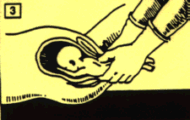
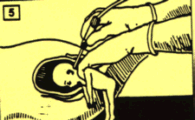
Partial-Birth abortions became illegal when the Supreme Court allowed a ban against them to stand. The court had previously ruled against the ban, and the law was sent back with minor changes after a new justice was confirmed.  It was a very long battle to ban this type of abortion, which usually took place between 20 and 26 weeks. Here are some pictures of how these abortions were performed.
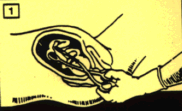
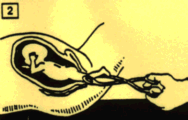
Prominent abortionist Dr. Martin Haskell, who performed the abortion Brenda watched, was asked about the diagram in an interview, and answered that it was “accurate from a technical point of view.”

(AMA- American Medical News July 5, 1993)

He describes partial-birth abortion this way:

“At this point, the right-handed surgeon slides the fingers of the left had [sic] along the back of the fetus and “hooks” the shoulders of the fetus with the index and ring fingers (palm down). Next he slides the tip of the middle finger along the spine towards the skull while applying traction to the shoulders and lower extremities. The middle finger lifts and pushes the anterior cervical lip out of the way.

While maintaining this tension, lifting the cervix and applying traction to the shoulders with the fingers of the left hand, the surgeon takes a pair of blunt curved Metzenbaum scissors in the right hand. He carefully advances the tip, curved down, along the spine and under his middle finger until he feels it contact the base of the skull under the tip of his middle finger.

Reassessing proper placement of the closed scissors tip and safe elevation of the cervix, the surgeon then forces the scissors into the base of the skull or into the foramen magnum. Having safely entered the skull, he spreads the scissors to enlarge the opening.

The surgeon removes the scissors and introduces the suction catheter into the hole and evacuates the skull contents. With the catheter still in place, he applies traction to the fetus, removing it completely from the patient.”

He then goes on to say that the procedure can be used essentially all the way to birth.

“The author is aware of one other surgeon [J McMahon, now deceased] who uses a conceptually similar technique…Coupled with other refinements and a slower operating time, he performs these procedures up to 32 weeks or more.”

Martin Haskell, M.D. “Dilation and Extraction for Late Second Trimester Abortion” Contained in National Abortion Federation “Second Trimester Abortion: From Every Angle.” Fall Risk Management Seminar, September 13-14, Dallas, Texas. Presentations, Bibliography and Related Materials. 1992

Share on Facebook

Dr. Leroy Carhart, on Sucking the Brains out of Children

Dr. Carhart performed partial-birth abortions and fought against laws forbidding partial-birth abortions. in his speech to the religious coalition for reproductive choice, he puts things in perspective:

“We’re not asking for the right to suck the brains out of every child that walks down the street, we need to continue to offer safe abortions to women who need them to be done.”

Dr. LeRoy Carhart, addressing the Religious Coalition for Reproductive Choice, Omaha World-Herald, 1/2001

24 week-old unborn baby, a typical candidate for a partial birth abortion
Share on Facebook

Keith L. Moore, The Developing Human: Clinically Oriented Embryology, 7th edition On Life

Keith L. Moore, The Developing Human: Clinically Oriented Embryology, 7th edition. Philadelphia, PA: Saunders, 2003. pp. 16, 2.

“Human life begins at fertilization, the process during which a male gamete or sperm (spermatozoo developmentn) unites with a female gamete or oocyte (ovum) to form a single cell called a zygote. This highly specialized, totipotent cell marked the beginning of each of us as a unique individual.” “A zygote is the beginning of a new human being (i.e., an embryo).”

Share on Facebook

Langman’s Medical Embryology On the Beginning of Life

T.W. Sadler, Langman’s Medical Embryology, 10th edition. Philadelphia, PA: Lippincott Williams & Wilkins, 2006. p. 11.

“Development begins with fertilization, the process by which the male gamete, the sperm, and the femal gamete, the oocyte, unite to give rise to a zygote.”

Share on Facebook

Before We Are Born: Essentials of Embryology, 7th edition on Human Beginnings

Keith L. Moore, Before We Are Born: Essentials of Embryology, 7th edition. Philadelphia, PA: Saunders, 2008. p. 2.

“[The zygote], formed by the union of an oocyte and a sperm, is the beginning of a new human being.”

Share on Facebook

Human Embryology and Teratology, 3rd edition, On Fertilization

Ronan O’Rahilly and Fabiola Miller, Human Embryology and Teratology, 3rd edition. New York: Wiley-Liss, 2001. p. 8.

“Although life is a continuous process, fertilization… is a critical landmark because, under ordinary circumstances, a new genetically distinct human organism is formed when the chromosomes of the male and female pronuclei blend in the oocyte.”

Share on Facebook

Textbook The Human Reproductive System On the Beginning of Life

“[All] organisms, however large and complex they might be as full grown, begin life as a single cell. This is true for the human being, for instance, who begins life as a fertilized ovum.”

Dr. Morris Krieger “The Human Reproductive System” p 88 (1969) Sterling Pub. Co

Share on Facebook

Human Life and Health Care Ethics, vol. 2: Conception Is the Beginning of Life

“The first cell of a new and unique human life begins existence at the moment of conception (fertilization) when one living sperm from the father joins with one living ovum from the mother. It is in this manner that human life passes from one generation to another. Given the appropriate environment and genetic composition, the single cell subsequently gives rise to trillions of specialized and integrated cells that compose the structures and functions of each individual human body. Every human being alive today and, as far as is known scientifically, every human being that ever existed, began his or her unique existence in this manner, i.e., as one cell. If this first cell or any subsequent configuration of cells perishes, the individual dies, ceasing to exist in matter as a living being. There are no known exceptions to this rule in the field of human biology.”

James Bopp, ed., Human Life and Health Care Ethics, vol. 2 (Frederick, MD: University Publications of America, 1985)

Share on Facebook

Textbook Atlas of the Body On the Start of a New Individual

Rand McNally, Atlas of the Body (New York: Rand McNally, 1980) 139, 144

“In fusing together, the male and female gametes produce a fertilized single cell, the zygote, which is the start of a new individual.”

Quoted in Randy Alcorn “Pro-life Answers to Pro-Choice Arguments” (Sisters, Oregon: Multnomah Publishers, 2000)

Share on Facebook

US Department of Health and Human Services on Newly Conceived Life

“Your baby starts out as a fertilized egg…For the first six weeks, the baby is called an embryo.”

Prenatal Care, US Department of Health and Human Services, Maternal and Child Health Div 1990

Share on Facebook