Baby Survives; Born at 23 Weeks

Jacob McMahon became Britain’s most premature surviving twin after he was born on February 22, just 23 weeks into pregnancy, at a weight of 1lb 4oz.

baby Jacob, born at 23 weeks – abortion is legal at this age everywhere in the United States

Hospital officials encouraged Jacob’s mother to abort after she miscarried his twin.

Nick Collins “Premature baby survives after doctors advised abortion” The Telegraph July 2011

Share on Facebook

Planned Parenthood Opposes Giving Women Options

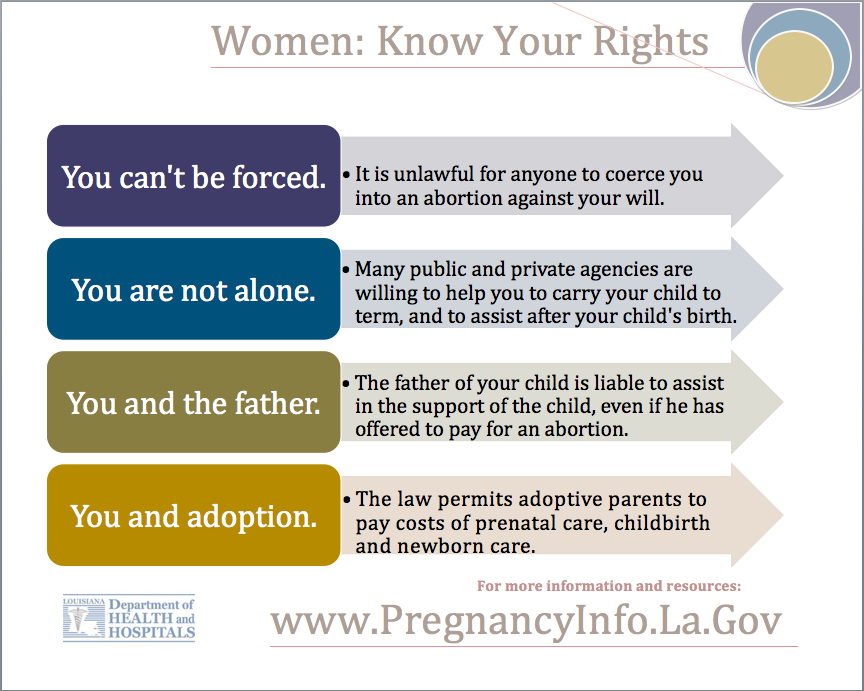
Louisiana requires abortion clinics to post signs giving women more information and telling them they cannot be coerced into an abortion against their will.

Here is the sign:

How could abortion clinics have a problem with this? After all, don’t clinics counsel their abortion patients and tell them these things anyway? Apparently not. Planned Parenthood fought this law – they called the signs “offensive.”

Why does Planned Parenthood consider it offensive to tell a woman she cannot be coerced into an abortion she doesn’t want? What are they find unacceptable that she be offered options, told her there is help for her if she chooses not to have an abortion? If they are pro-choice, why are they upset with the sign?

Steven Ertelt . Innovative Pro-Life Law Uses Phones, Computers to Help Women” LifeNews  July 4, 2011

For more information about abortion the quality of counseling in abortion clinics, go here

Share on Facebook

Pro-Lifer Conceived in Rape Speaks out

A Human Life International Employee conceived in rape:

“I am sure happy that my life  was not cut off because of a crime my biological father committed. I am grateful for the life I am living and I know, even though I am far from perfect, my mom has no regrets either. Despite the circumstances of my conception, once I exist, I have the right to life, just as you or anyone else does – for it IS an inalienable right.”

http://www.humanlife.org/abortion_tiredofrhetoric.php

Many people support abortion in cases where the mother is a victim of rape – but few think about the unborn baby, who was an innocent victim as well. Here’s a picture of an abortion at eight weeks. You can’t tell if the baby killed in this abortion was conceived by rape or not. Either way, it’s a violent death for the baby.

Often abortion, even in cases of rape or incest, is not in the best interest of the woman either. Read some testimonies of women were raped and became pregnant here.


Share on Facebook

Violence and Extremist Tactics Strengthen Pro-Choice Resolve

A book by a pro-choice author discusses how antiabortion extremist tactics lead to more medical students becoming abortion providers:

Since David Gunn’s death in March 1993, there has been a significant mobilization among pro-choice medical students across the country. “Medical Students for Choice,” a new national organization, has contacts in over 100 medical schools. One of its first activities was to circulate a petition (which ultimately gathered over 3000 signatures) among medical students all over the country, demanding that abortion training be a required component in OB/GYN residency programs.… In Response to the notorious “Bottom Feeders pamphlet, a compilation of vulgar jokes directed at abortion providers, which was recently mailed to medical students in the United States by an antiabortion group, medical students at the University of California at San Francisco raised funds that were donated to the National Abortion Federation.

In a letter to the publishers of the pamphlet, the UCSF students wrote, “If your intentions included intimidating future abortion providers… Then you failed. In fact, “Bottom Feeders” has sparked effective discussions on-campus about how to ensure access to safe, legal abortion for every woman who wants one.”

Carole Joffe. Doctors of Conscience: the Struggle to Provide Abortion before and after Roe Versus Wade (Boston, Massachusetts: Beacon press, 1995)  206 – 207


Share on Facebook

Media Event In Front of Clinic Works in Abortionist’s Favor

Is holding big media events outside abortion clinics during pickets counterproductive? It can be. According to an abortionist named Caleb Barrington:

“They [pro-lifers]would stage a picket at the office and would at the same time make it a media event. They would call the press, they would all arrive, and the next day I would get twice as many phone calls because people would know I was doing the abortions – so, in fact, they made my name known.”

Doctors of Conscience: the Struggle to Provide Abortion before and after Roe Versus Wade (Boston, Massachusetts: Beacon press, 1995) 165

Share on Facebook

100 OB/GYN’s Express Doubts About Abortion

In 1972, the year before Roe versus Wade, a collection of 100 OB/GYN’s published an article in the American Journal of Obstetrics and Gynecology. They expressed doubts about the legalization of abortion. Concern that women may want surgery that is not in their best interest, they said the following:

“For the first time, except perhaps for cosmetic surgery, doctors will be expected to do an operation simply because the patient asks that it be done.”

“A Statement on Abortion by One Hundred Professors of Obstetrics” American Journal of Obstetrics and Gynecology 112 (1972) 992 – 98

They realized that the doctor would be a mere technician, performing a service that women wanted without knowing their in-depth medical history or life circumstances. Perhaps these doctors envisioned clinics where women would wait in line and be aborted one after the other with the doctor only seeing his patients for several minutes on the operating table. Is this really conducive to good medical care?

Share on Facebook

Antiabortion Violence Fuels Misconceptions

Some misguided antiabortion activists (they are not “pro-life”) have taken part in clinic bombings and violence against abortion providers. These actions are immoral, but also, they work in the abortion industry’s favor.

Abortionist Dr. Zachary Harris said the following when his clinic was firebombed:

“I think all that does is simply add to the public perception that the antiabortion people are crazy and will stop at nothing… They’re a bunch of lunatics and every time there’s something like that, it evokes a little more sympathy from the community toward what we’re doing. I think it’s totally counterproductive.”

Carole Joffe. Doctors of Conscience: the Struggle to Provide Abortion before and after Roe Versus Wade (Boston, Massachusetts: Beacon press, 1995) 163

Perhaps part of the reason why so many people look down on the pro-life movement and are unsympathetic to its claims is that misguided activists have engaged in violence. How can anyone take the pro-life movement seriously when individual pro-lifers are doing things that disrespect life? The lives of abortion patients and doctors are as important as the lives of the unborn babies.

Violence against abortion providers distracts from the very real baby that is the victim of violence in abortion.

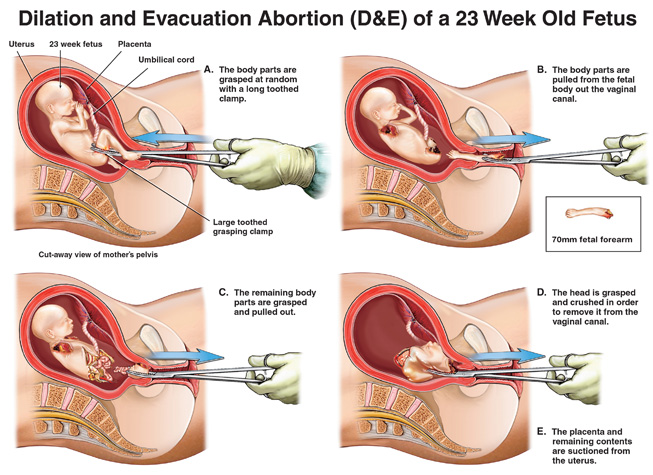
Below are diagrams of the two most common abortion procedures – a suction abortion, performed in the first trimester, and a D&E abortion performed in the second and early third.

Share on Facebook

More Information on RU-486 Abortions

An FDA, report, dated April 30, 2011, says that 14 women in the United States alone have died from using the mifepristone (RU-486) abortion drug and 2,207 women have been injured by it.

According to an article by Steven Ertelt:

Of the women experiencing medical and physical problems resulting from the abortion drug, 612 women required hospitalizations, 339 experienced blood loss significant enough to require a transfusion, 256 experienced infections and 48 women experienced what the FDA labeled as “severe infections.”

“Severe infections generally involve death or hospitalization for at least 2-3 days, intravenous antibiotics for at least 24 hours, total antibiotic usage for at least 3 days, and any other physical or clinical findings, laboratory data or surgery that suggest a severe infection,” the FDA report states.

Women developing infections from usage of the RU 486 abortion drug experienced endometritis (involving the lining of the womb), pelvic inflammatory disease (involving the nearby reproductive organs such as the fallopian tubes or ovaries), and pelvic infections with sepsis (a serious systemic infection that has spread beyond the reproductive organs).

The FDA figures also reveal that abortion businesses like Planned Parenthood are still misusing the abortion drug.

Despite the FDA indicating, “Administration of mifepristone and misoprostol is contraindicated in patients with confirmed or suspected ectopic pregnancy (a pregnancy outside the uterus,” the abortion drug was given to women in 58 cases where they had an ectopic pregnancy.

Steven Ertelt “New FDA Report: Abortion Drug Kills 14 Women, Injures 2,200” LifeNews.com | 7/12/11

For more information on RU-486, go here.

Share on Facebook

Planned Parenthood on Coping After an Abortion

So many women were having emotional problems after their abortions that Planned Parenthood, which always denies that post abortion trauma is real, finally had to address the issue.

Planned Parenthood website affiliate in Illinois about coping with an abortion

“You can say or yell “stop” whenever you have disturbing thoughts… if you find yourself fantasizing too often about what the child may have been like, you should substitute another fantasy: a baby crying because you have no time to give  it.”

Quoted in Valerie Meehan “Hidden Pain: Silent No More” The American Feminist, Winter 2002 to 2003

Meehan quotes from Theresa Burke, PhD “forbidden grief, the unspoken pain of abortion” written with David Reardon

Here are the results of some studies on abortion and the emotional aftermath:

154% higher risk of suicide. Another study of more than 173,000 American women who had abortions or carried to term found that, during the eight years after the pregnancy ended, women who aborted had a 154% higher risk of suicide than women who carried to term.

DC Reardon et. al., “Deaths Associated With Pregnancy Outcome: A Record Linkage Study of Low Income Women,” Southern Medical Journal 95(8):834-41, Aug. 2002.

Higher suicide risks for teens. Teen girls are 10 times more likely to attempt suicide if they have had an abortion in the last six months than girls who have not had an abortion, and 2-4 times more likely to commit suicide after abortion compared to adult women

B. Garfinkel, et al., “Stress, Depression and Suicide: A Study of Adolescents in Minnesota,” Responding to High Risk Youth (University of Minnesota: Minnesota Extension Service, 1986); M. Gissler, et. al., “Suicides After Pregnancy in Finland: 1987-94: register linkage study,” British Medical Journal, 313: 1431-1434, 1996; and N. Campbell, et. al., “Abortion in Adolescence,” Adolescence, 23:813-823, 1988. See the “Teen Abortion Risks” Fact Sheet at www.unfairchoice.info/resources.htm for more information.

Five-fold higher risk of drug and alcohol abuse. Excluding women with a prior history of substance abuse, those who abort their first pregnancy are 5 times more likely to report subsequent drug and alcohol abuse vs. those who give birth.

DC Reardon, PG Ney, “Abortion and Subsequent Substance Abuse,” American Journal of Drug and Alcohol Abuse 26(1):61-75, 2000.

For more studies on the mental fallout from abortions, go here.

For testimonies and stories of post-abortion women, go here. 

Share on Facebook

Abortion is a Woman’s Choice?

In a well-known pro-choice book,an author who observed in an abortion clinic told of the abortion decision of a young women who already had a two year old. Lamenting the fact that she could not have her baby and stay financially afloat, the woman said:

“This is my decision but not my choice.”

Chalker R. and Downes, C. “A Woman’s Book of Choices: Abortion, Menstrual Extraction, RU-486” (Four Walls Eight Windows, New York 1992) Quoted in an essay by Catherine Spencer

The truth is, many women have abortions not because they are deciding without qualms that they don’t want a baby, but, rather, that they see themselves in a hopeless situation, and feel they have no other choice. Or, just as often, they are pressured by other people (usually the baby’s father) into having the abortion.

To read more about coerced abortions, go here. 

Share on Facebook