In December 1999, the Nebraska University Regents board met to discuss partial-birth abortions, which were being performed by Dr. Leroy Carhart at the University of Nebraska medical center.. A reading of the testimony was taped and played a local radio program the following Monday, introducing it into the public arena. Dr. Carhart was under oath.
“Are there times when you don’t remove the fetus intact?
Carhart: yes, Sir.
Can you tell me about that – when that occurs?
Carhart: That occurs when the tissue fragments, or frequently when you rupture the membranes. An arm will spontaneously prolapse through the os… We talk about the forehead and the skull being first. We talked about the feet being first, but I think in probably the great majority of terminations, it’s what they would call a transverse lie; so really you’re looking at a side profile of a curved fetus when the patient’s uterus is already starting to contract, and they are starting to miscarry, when you rupture the waters, usually something prolapses through the uterine, through the cervical os, not always but very often an extremity will.
What do you do then?
Carhart: My normal course would be to dismember that extremity and then go back and try to take the fetus out either foot or skull first, whatever end I can get to first.
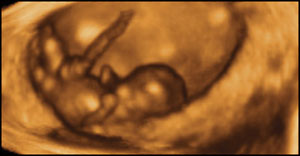
Unborn baby 22-24 weeks
How do you go about dismembering that extremity?
Carhart: Just traction and rotation, grasping the portion that you can get a hold of which would be usually somewhere up the shaft of the exposed portion of the fetus, pulling down on it through the os, using the internal os as your counter traction and rotating to dismember the shoulder or the hip or whatever it would be. Sometimes you will get one leg and you can’t get the other leg out.
In that situation… Are you… When you pull on the arm and remove it, is the fetus still alive?
Carhart: Yes.
Do you consider an arm, for example, to be substantial portion of the fetus?
Carhart: In the way I read it, I think if I lost my arm, that would be a substantial loss to me. I think I would have to interpret it that way.
And then what happens if you remove the arm? You then try to remove the rest of the fetus?
Carhart: Then I would go back and attempt to either bring the feet down or bring the skull down, or even sometimes you bring the other arm down and remove that also and then get the feet down.
At what point is the fetus… Does the fetus die during that process?
Carhart: I don’t really know. I know that the fetus is alive during the process most of the time because I can see the fetal heartbeat on the ultrasound.
The Court: counsel, for what it’s worth, it still is unclear to me with regard to the intact D&E when fetal demise occurs.
Okay, I will try to clarify that. In the procedure of an intact D&E where you would start foot first, with the situation where the fetus is presented feet first, tell me how you’re able to get the feet out first
Carhart: Under ultrasound, you can see the extremities. You know what is what. You know what the foot is, you know what the arm is, you know what the skull is. By grabbing the feet and pulling down on it, or by grabbing a knee and pulling down on it, usually you can get one leg out, get the other leg out, and bring the fetus out. I don’t know where this… All the controversy about rotating the fetus comes from. I don’t attempt to do that – just attempt to bring out whatever is the proximal portion of the fetus.
At the time you bring out the feet, in this example, is the fetus still alive?
Carhart: Yes.
Then what’s the next step you do?
Carhart: I didn’t mention it. I should. I usually attempt to grasp the cord first and divide the cord, if I can do that.
What is the cord?
Carhart: The cord is the structure that transports the blood, both arterial and venous, from the fetus to the back of the fetus, and it gives the fetus it’s only source of oxygen, so that if you can divide the cord, the fetus will eventually die, but whether this takes 5 min. or 15 min. and when that occurs, I don’t think anyone really knows.
Are there situations where you don’t divide the cord?
Carhart: There situations when I can’t.
What are those?
Carhart: I just can’t get to the cord. It’s either high above the fetus and structures where you can’t reach up that far. The instruments are only 11 inches long
Let’s take the situation where you haven’t divided the cord because you couldn’t, and you have begun to remove a living fetus feetfirst. What happens next after you have gotten the feet removed?
Carhart: We remove the feet and continue with traction on the feet until the abdomen and the thorax come through the cavity. At that point, I would try… You have to bring the shoulders down, but you can get enough of them outside, you can do this with your finger outside the uterus, and then at that point the fetal… The base of the fetal skull is usually in the cervical canal.
What do you do next?
Carhart: And you can reach that, and that’s where you would rupture the fetal skull to some extent and aspirate the contents out.
At what point in that process does fetal demise occur between initial remove… Removal of the feet or legs and the crushing of the skull or – I’m sorry – the decompressing of the skull?
Carhart: Well, you know, again, this is where I’m not sure what fetal demise is. I mean, I honestly have to share your concern, your honor. You can remove the cranial contents and the fetus will still have a heartbeat for several seconds or several minutes; so is the fetus alive? I would have to say probably, although I don’t think it has any brain function, so it’s brain-dead at that point.
So the brain death might occur when you begin suctioning out of the cranium?
Carhart: I think brain death would occur because the suctioning to remove contents is only two or 3 seconds, so somewhere in that period of time, obviously not when you penetrate the skull, because people get shot in the head and they don’t die immediately from that, if they’re going to die at all, so that probably is not sufficient to kill the fetus, but I think removing the brain contents eventually will.”
Testimony of Leroy Carhart, M.D. Quoted in Randy Alcorn “Pro-life Answers to Pro-Choice Arguments” (Sisters, Oregon: Multnomah Publishers, 2000) page 207-208
Less has been written about men and abortion. But abortion often effects them as well. In an article in Equire magazine, one man said the following of his experience with abortion.
“Abortion is presented to you as something that is easy to do. It doesn’t take very long. It doesn’t cost very much money nowadays, for a middle-class person. You say, “Well, it’s okay.” But it wasn’t okay. It left a scar, and the scar had to be treated tenderly and worked on in order for us to get on with our lives. I don’t think abortion is easy for anybody. The people who say it’s easy either don’t want to face the pain or they haven’t been through it, because it’s really a tough experience.”
Mark Baker, “Men on Abortion” Esquire, March 1990, 114 to 125. Quoted in Randy Alcorn “Pro-life Answers to Pro-Choice Arguments” (Sisters, Oregon: Multnomah Publishers, 2000)
Catherine Anthony Adair worked in a Planned Parenthood clinic. She left her job and now is a part of the pro-life movement. Here is an interview that Clinicquotes did with her.
What were your feelings on abortion before you got the job at the clinic?
I really didn’t have any feelings on it, I was much more concerned about feminism and women’s rights, and I felt that abortion, as a politic issue, was part of the feminist framework of forwarding women’s rights. I didn’t have any understanding that abortion could/did have any negative implications for women, and I certainly didn’t consider the baby involved. Looking back, I can see that my own abortion I had several years before working at Planned Parenthood greatly affected my views in abortion. I had found it highly traumatizing, and my way of dealing with the emotional aftermath was to bury it and not deal with my emotions. Instead, I turned to radical feminism.
How did you decide to work there, what led up to that decision?
I was finishing college and looking for a job when I saw Planned Parenthood was looking for clinic workers. I jumped at the chance because to me Planned Parenthood represented the feminist movement.
When the women came in for an abortion, did they receive counseling before hand?
The clinic where I worked was almost exclusively an abortion clinic. Abortions were performed all day, every day. The counseling occurred after the woman had paid for her abortion. The counseling was not meant to be an opportunity to discuss the woman’s decision to abort. It was merely a pre-operative screening. We went over her health questionnaire she filled out in the waiting room, I took her blood pressure and pulse, described the abortion procedure, and made sure she chose a birth control method to use when she left the clinic.I never once asked what had led the woman to choose abortion – the attitude was that she was already there so she must be sure. We did have to ask her if she was aware she could continue her pregnancy and give the baby up for adoption, but we didn’t get into any options counseling. We weren’t under any pressure to sell abortions, they had already been paid for by the time they came into the counseling room.
We never discussed fetal development. The baby was referred to as the”contents of the uterus” or a “clump of cells.” on the rare occasion a woman asked about the size of the baby, I would tell her it was about the size of the tip of my pencil, regardless of how many weeks into her pregnancy she was.At the time I worked for Planned Parenthood ultrasounds were only done if the woman was unsure of the dates of her last menstrual period,or if the doctor ordered one.
ultrasound at 8 weeks
Women were not given the option of viewing the ultrasound.
Did you ever witness an abortion procedure? What did you see?
I was a medical assistant in the room for hundreds of abortions. I witnessed the baby being suctioned out of the uterus and watched blood and tissue work it’s way through the tube into a metal bowl. The baby was dismembered during the process. The nurse would account for the baby parts and put it into a baggy, which I then put in a box with the other aborted babies. We then had to count them at the end of the day to ensure we had all of them to go to the lab.
When I saw a second trimester abortion, I saw dismembered arms and legs, with perfect feet and hands.
legs of an eleven week old unborn baby
What (if any) services did the clinic offer to post-abortion women? Was there a follow up appointment or any counseling offered?
We did not offer any post-abortive services, except for the occasional patient who chose to have her 6 week follow-up at the clinic. Most women saw their own doctor. There was absolutely no talk of any kind of mental health help or counseling, because that would have been tantamount to admitting that women suffer emotionally after abortion and Planned Parenthood is always going to deny that.
What led to you leaving the clinic?
I left the clinic for several reasons. First, I had become very disillusioned. I realized that Planned Parenthood was not the feminist place I thought it was. I realized it was racist, classist, and demeaning for women. I also was having terrible nightmares and anxiety attacks. One of my recurring nightmares was me floating through space in a sea of baby limbs torn from their bodies. In the dream I couldn’t breath or escape – I would wake up screaming. I couldn’t deal with it emotionally, so I left and I didn’t talk about my experience for over a decade.
Though I’d been with Planned Parenthood for eight years, I had never been called into the exam room to help the medical team during an abortion, and I had no idea why I was needed now. Nurse-practitioners were the ones who assisted in abortions, not the other clinic staff. As director of this clinic in Bryan, Texas, I was able to fill in for any position in a pinch, except, of course, for doctors or nurses performing medical procedures. I had, on a few occasions, agreed at a patient’s request to stay with her and even hold her hand during the procedure, but only when I’d been the counselor who’d worked with her during intake and counseling. That was not the case today. So why did they need me?
Today’s visiting abortionist had been here at the Bryan clinic only two or three times before. He had a private abortion practice about 100 miles away. When I’d talked with him about the job several weeks before, he had explained that at his own facility he did only ultrasound-guided abortions — the abortion procedure with the least risk of complications for the woman. Because this method allows the doctor to see exactly what is going on inside the uterus, there is less chance of perforating the uterine wall, one of the risks of abortion. I respected that about him. The more that could be done to keep women safe and healthy, the better, as far as I was concerned. However, I’d explained to him that this practice wasn’t the protocol at our clinic. He understood and said he’d follow our typical procedures, though we agreed he’d be free to use ultrasound if he felt a particular situation warranted it.
To my knowledge, we’d never done ultrasound-guided abortions at our facility. We did abortions only every other Saturday, and the assigned goal from our Planned Parenthood affiliate was to perform 25 to 35 procedures on those days. We liked to wrap them up by around 2 p.m. Our typical procedure took about 10 minutes, but an ultrasound added about five minutes, and when you’re trying to schedule up to 35 abortions in a day, those extra minutes add up.
I felt a moment’s reluctance outside the exam room. I never liked entering this room during an abortion procedure — never welcomed what happened behind this door. But since we all had to be ready at any time to pitch in and get the job done, I pushed the door open and stepped in.
The patient was already sedated, still conscious but groggy, the doctor’s brilliant light beaming down on her. She was in position, the instruments were laid out neatly on the tray next to the doctor, and the nurse-practitioner was positioning the ultrasound machine next to the operating table.
“I’m going to perform an ultrasound-guided abortion on this patient. I need you to hold the ultrasound probe,” the doctor explained.
As I took the ultrasound probe in hand and adjusted the settings on the machine, I argued with myself, I don’t want to be here. I don’t want to take part in an abortion. No, wrong attitude — I needed to psych myself up for this task. I took a deep breath and tried to tune in to the music from the radio playing softly in the background. It’s a good learning experience — I’ve never seen an ultrasound-guided abortion before, I told myself. Maybe this will help me when I counsel women. I’ll learn firsthand about this safer procedure. Besides, it will be over in just a few minutes. I could not have imagined how the next 10 minutes would shake the foundation of my values and change the course of my life.
I had occasionally performed diagnostic ultrasounds for clients before. It was one of the services we offered to confirm pregnancies and estimate how far along they were. The familiarity of preparing for an ultrasound soothed my uneasiness at being in this room. I applied the lubricant to the patient’s belly, then maneuvered the ultrasound probe until her uterus was displayed on the screen and adjusted the probe’s position to capture the image of the fetus.
I was expecting to see what I had seen in past ultrasounds. Usually, depending on how far along the pregnancy was and how the fetus was turned, I’d first see a leg, or the head, or some partial image of the torso, and would need to maneuver a bit to get the best possible image. But this time, the image was complete. I could see the entire, perfect profile of a baby.
It looks just like Grace at 12 weeks, I thought, surprised, remembering my very first peek at my daughter, three years before, snuggled securely inside my womb. The image now before me looked the same, only clearer, sharper. The detail startled me. I could clearly see the profile of the head, both arms, legs, and even tiny fingers and toes. Perfect.
And just that quickly, the flutter of the warm memory of Grace was replaced with a surge of anxiety. What am I about to see? My stomach tightened. I don’t want to watch what is about to happen.
I suppose that sounds odd coming from a professional who’d been running a Planned Parenthood clinic for two years, counseling women in crisis, scheduling abortions, reviewing the clinic’s monthly budget reports, hiring and training staff. But odd or not, the simple fact is, I had never been interested in promoting abortion. I’d come to Planned Parenthood eight years before, believing that its purpose was primarily to prevent unwanted pregnancies, thereby reducing the number of abortions. That had certainly been my goal. And I believed that Planned Parenthood saved lives — the lives of women who, without the services provided by this organization, might resort to some back-alley butcher. All of this sped through my mind as I carefully held the probe in place.
“Thirteen weeks,” I heard the nurse say after taking measurements to determine the fetus’s age.
“Okay,” the doctor said, looking at me, “just hold the probe in place during the procedure so I can see what I’m doing.” The cool air of the exam room left me feeling chilled. My eyes still glued to the image of this perfectly formed baby, I watched as a new image entered the video screen. The cannula — a strawshaped instrument attached to the end of the suction tube — had been inserted into the uterus and was nearing the baby’s side. It looked like an invader on the screen, out of place. Wrong. It just looked wrong.
My heart sped up. Time slowed. I didn’t want to look, but I didn’t want to stop looking either. I couldn’t not watch. I was horrified, but fascinated at the same time, like a gawker slowing as he drives past some horrific automobile wreck—not wanting to see a mangled body, but looking all the same.
My eyes flew to the patient’s face; tears flowed from the corners of her eyes. I could see she was in pain. The nurse dabbed the woman’s face with a tissue.
“Just breathe,” the nurse gently coached her. “Breathe.” “It’s almost over,” I whispered. I wanted to stay focused on her, but my eyes shot back to the image on the screen.
At first, the baby didn’t seem aware of the cannula. It gently probed the baby’s side, and for a quick second I felt relief. Of course, I thought. The fetus doesn’t feel pain. I had reassured countless women of this as I’d been taught by Planned Parenthood. The fetal tissue feels nothing as it is removed. Get a grip, Abby. This is a simple, quick medical procedure. My head was working hard to control my responses, but I couldn’t shake an inner disquiet that was quickly mounting to horror as I watched the screen.
The next movement was the sudden jerk of a tiny foot as the baby started kicking, as if it were trying to move away from the probing invader. As the cannula pressed its side, the baby began struggling to turn and twist away. It seemed clear to me that it could feel the cannula, and it did not like what it was feeling. And then the doctor’s voice broke through, startling me.
“Beam me up, Scotty,” he said lightheartedly to the nurse. He was telling her to turn on the suction — in an abortion the suction isn’t turned on until the doctor feels he has the cannula in exactly the right place.
I had a sudden urge to yell, “Stop!” To shake the woman and say, “Look at what is happening to your baby! Wake up! Hurry! Stop them!”
But even as I thought those words, I looked at my own hand holding the probe. I was one of “them” performing this act. My eyes shot back to the screen again. The cannula was already being rotated by the doctor, and now I could see the tiny body violently twisting with it. For the briefest moment the baby looked as if it were being wrung like a dishcloth, twirled and squeezed. And then it crumpled and began disappearing into the cannula before my eyes. The last thing I saw was the tiny, perfectly formed backbone sucked into the tube, and then it was gone. And the uterus was empty. Totally empty.
I was frozen in disbelief. Without realizing it, I let go of the probe. It slipped off the patient’s tummy and slid onto her leg. I could feel my heart pounding — pounding so hard my neck throbbed. I tried to get a deep breath but couldn’t seem to breathe in or out. I still stared at the screen, even though it was black now because I’d lost the image. But nothing was registering to me. I felt too stunned and shaken to move. I was aware of the doctor and nurse casually chatting as they worked, but it sounded distant, like vague background noise, hard to hear over the pounding of my own blood in my ears.
The image of the tiny body, mangled and sucked away, was replaying in my mind, and with it the image of Grace’s first ultrasound — how she’d been about the same size. And I could hear in my memory one of the many arguments I’d had with my husband, Doug, about abortion.
“When you were pregnant with Grace, it wasn’t a fetus; it was a baby,” Doug had said. And now it hit me like a lightning bolt: He was right! What was in this woman’s womb just a moment ago was alive. It wasn’t just tissue, just cells. It was a human baby.
And it was fighting for its life! A battle it lost in the blink of an eye. What I have told people for years, what I’ve believed and taught and defended, is a lie.”
A pro-choice feminist who observed at an abortion clinic told the following story of a woman who came in for an abortion:
“The second woman was Japanese and spoke very little English, and she had not brought anyone to translate.… This woman actively resisted… She was very drugged up – Demerol and Valium on top of the Sublimaze. She wouldn’t keep her legs open and kept sliding up on the table. From the second Roger first touched her, she looked like she was in agony.
What happened was that three people held her down, basically. Julia and Toby held her legs apart, and Ilene, who was assisting, held her at the waist to keep her from sliding up. I stood at her side and tried to get her to do deep breathing, pretty ineffectually. It was horrible to watch… Roger looked very annoyed during the whole thing. Toby told me later that when Julia was first encouraging the woman to take deep breaths, Roger said, “This will make or breathe!” And slid in the speculum roughly. I had thought of him as very compassionate but apparently not when things don’t go well. I wonder what that woman was thinking during the whole thing.”
Wendy Simonds. Abortion at Work: Ideology and Practice in a Feminist Clinic (New Brunswick, New Jersey: Rutgers University Press, 1996) 75
On November 2nd, 2012 the organization 40 Days for Life, which arranges prayer campaigns and protests outside abortion clinics, told the following stories:
In Michigan:
A woman visited the pregnancy help center just down the street from the 40 Days for Life vigil – after “a nice man” praying at the abortion center gave her a coupon for a free ultrasound.
She said she had gone into the abortion facility and planned to have an abortion. They did an ultrasound first – and she asked to see the screen. “Is that my baby’s head?” she asked. She was told, “Yes, but it’s just a blob.”
They started the procedure, but it was painful for her and she made them stop. They let her off the table so she could calm down a bit before trying again. But once off the table, she had made up her mind not to go through with it.
A few days later, she showed up at the pregnancy center. She and the ultrasound tech watched as the baby seemed to wave, jump and turn. They listened to the baby’s heartbeat … and tears of joy fell from her eyes. She was so happy to have this precious child safe and secure.
Here is a picture of her unborn baby, the picture that changed her mind:
Another story came from Bakersfield California:
A woman had made the long drive from another county for an abortion appointment. She was one of the first to arrive that day, walking past the vigil participants and into the building.
As she was leaving, the volunteers noted that she might have been inside long enough for the abortion. They also noted that she was crying, so one of them asked her, “Is there anything I can do to help?”
“I couldn’t do it,” the woman said. “They were doing an ultrasound, so I asked if I could see it. At first they refused, telling me ‘you don’t really want to see it.’ But I insisted ‘yeah, I do want to see it, because if I can see it … maybe I won’t do it.’”
She was right. Once she saw her nine week baby on the ultrasound screen, she knew that she couldn’t go through with the abortion.
Do women ever get abortions because the baby is the wrong gender? one abortionist recounts a story:
“In one case, a woman who was in her late thirties, well educated, and a professional person with healthy children requested an abortion for the reason that the fetus was male…The fetus was normal but it was male…
Even though I had begun by being totally opposed to an abortion for this reason, she persuaded me that, in her mind, abortion was the only choice she could accept for this pregnancy for her own mental health as well as the welfare of her family.
The lesson from this anecdote is that we, as abortion-service providers, cannot place moral judgments on the motives or actions of out patients.”
Jenny Jerrome has a page where she rates abortion clinics for women, advertising those that she feels best serve them. Here is some of the advice she gives pregnant women considering abortion:
“Don’t get sucked into one of those abortion options counseling centers. They will hound you and heap guilt on you and pound on you until they break down your spirit and force you to wait until it is too late. Then, they will abandon you and look down their noses at you.…
Don’t wait. Make your decision quickly it’s a hard thing to do, but the longer you wait, the fewer options you have. Take a day, (no more than one day) and make your decision. A favorite tactic of those who don’t want you to have a choice is to delay, find excuses for you to delay a little longer, and finally tell you, “tough luck honey, it’s too late!”
Crisis pregnancy centers have helped tens of thousands of pregnant women and new mothers, offering both emotional support and material help, including referrals for medical care and social services. Some crisis pregnancy centers follow the women for years, providing daycare assistance and parenting classes, and job training, whereas an abortion clinic will do her abortion and sent her home. Putting pressure on a pregnant woman to decide what to do about her pregnancy quickly is a common technique that abortion clinics use in order to convince women to have abortions. Studies show that the longer a woman waits to have an abortion, the more likely she is to change her mind and have her child. Abortion clinics know this.. They will often say that it will become too late to have an abortion if the woman does not abort immediately. In reality, abortion is legal for all nine months of pregnancy and over half of all abortion clinics perform abortions after 12 weeks.
Jerrome continues with her “good advice”:
Under “Who Will Know I Had an Abortion?”
“First, don’t tell anyone. If you told someone you were going to have an abortion, lie! Yes, lie! Tell them you started bleeding and it was suddenly all gone. Cry a little, if you can, and say you feel better and don’t want to talk about it… Remember, you can’t trust anyone with this. If you really don’t want anyone else to know, you have to keep it from your closest friends and family. You might be able to trust them now, but over time, things will change. Your relationship with them might change… Don’t tell and no one will know!”
Isolating the pregnant woman from her support system is one of the cruelest things that can be done to her. A woman should not be forced to go through an abortion decision on her own. Friends and loved ones can help a woman talk things out. Fear and and a sense of being alone often drive a person to choose something in a moment of crisis that they will regret for the rest of their lives. A woman should find out what support is available for her and her child if she chooses to carry the baby to term. Making a decision in isolation, without reaching out to anyone for help, can lead to devastating guilt and grief as well as undue pressure to have an abortion.
Not content with simply isolating a woman from her support system during her pregnancy, Jerrome takes it further and encourages her to lie about her abortion. This can set the course for a lifetime of denial and shame as the woman feels that she needs to hide this terrible secret from everyone she knows. It can be a major block to healing which needs to take place after an incident as traumatic as an abortion.
In an article in the Weekly Standard, the author says:
Two pro-choice leaders, Kate Michelman and Frances Kissling, acknowledged three years ago that “antiabortionists” had gained a significant advantage. Supporters of abortion, they wrote in the Los Angeles Times, “have had a hard time dealing with the increased visibility of the fetus.” To “regain the moral high ground,” they must deal with “a world that is radically changed from 1973,” when the Roe v. Wadedecision legalized abortion nationwide.
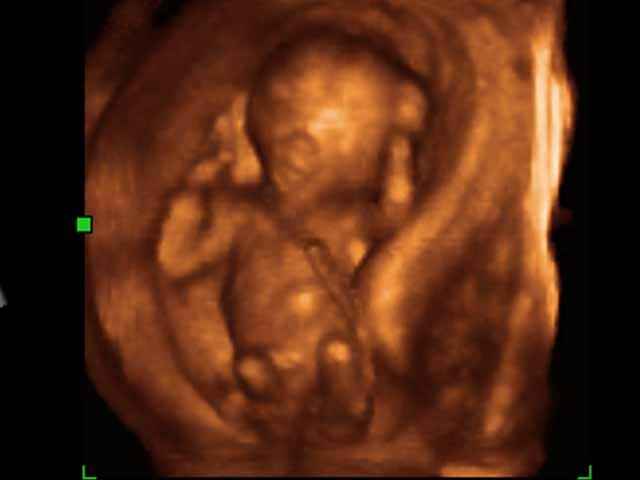
They are referring to pictures like the one below, which shows an unborn baby in the first trimester, the time when most abortions are performed
It is obvious that these images change hearts and minds, and pro-choice activists can no longer get away with arguing that the unborn baby is a clump of cells or blob of tissue. People can see the evidence with their own eyes. In fact, according to the article, 80 to 90 percent of the women who have sonograms at pregnancy centers choose to have their baby.
Perhaps this is why there is such a campaign against crisis pregnancy centers by pro-choicers who want to shut them down or at least deny them access to ultrasound machines. Pro-choice organizations bitterly fight laws that would require a woman to be offered the chance to view an ultrasound before her abortion.
Fred Barnes “Hidden Persuaders:The unheralded gains of the pro-life movement” The Weekly StandardNOV 7, 2011
Mother of a five-year-old girl with a cleft lip and palate wrote this letter to the editor:
“I was horrified to read that many couples now opt for abortion rather than risk having a baby with such a minor physical imperfection. My daughter is not some abnormal freak… She can, and does, lead a happy, fulfilled life… What sort of society do we live in when a minor facial deformity, correctable by surgery, is viewed as so abnormal as to merit abortion?”
Susan Kitching, London Sunday Times, February 11, 1990